Lesson 7: Euler and Advanced Customization
🎯 Core Concept: The Resilient Toolkit
Euler Finance's story is defined by resilience. After a $197M exploit in v1, Euler spent 18 months rebuilding from scratch, launching v2 in 2025 as one of the most secure and modular lending protocols—boasting 31+ audits and massive security competitions.
Key Innovation: Euler Vault Kit (EVK) + Ethereum Vault Connector (EVC) enable highly customized, permissionless vault creation with sub-accounts for granular risk isolation.
📜 The Evolution: v1 to v2
Euler v1: The Monolithic Era
What It Was:
- Permissionless lending protocol
- Uniswap v3 TWAP oracles (allowed any asset)
- Shared state across all assets
- Three-tier system (Isolation, Cross, Collateral)
The Failure (March 2023):
- $197M exploit via donateToReserves function
- Missing invariant check allowed debt-free donations
- Highlighted risks of tightly coupled logic
- Shared state meant one failure affected everything
The Recovery:
- Funds recovered through negotiation
- Team committed to complete rebuild
- 18-month development cycle
- Result: Euler v2
Euler v2: The Modular Rebirth
The Paradigm Shift: From "Pool" to "Vault" architecture
Core Changes:
- Independent ERC-4626 vaults (not single pool)
- Each vault manages own solvency
- Risk isolation at vault level
- Permissionless vault creation
🏗️ The Architecture: EVK and EVC
Euler Vault Kit (EVK)
What It Is: Factory for deploying ERC-4626 compliant lending vaults
Capabilities:
- Custom asset/liability logic
- Flexible interest rate models (linear, kinked, PID-controlled)
- Oracle agnostic (any oracle adapter)
- Nested vaults (vault shares as collateral)
Example Use Cases:
- Standard lending vault (like Aave)
- Synthetic asset vaults
- Sub-collateralized loans
- Complex reward structures
Ethereum Vault Connector (EVC)
What It Is: Communication layer enabling vault interoperability
Key Features:
- Sub-Accounts: Use deposits in Vault A as collateral for loan in Vault B
- Unified Account View: Check solvency across all enabled vaults
- Flash Liquidity: Flash loans across entire ecosystem
- Defer Checks: Batch operations, check solvency at end (gas savings)
The Power: Combines Aave's cross-margin efficiency with Morpho's isolation benefits.

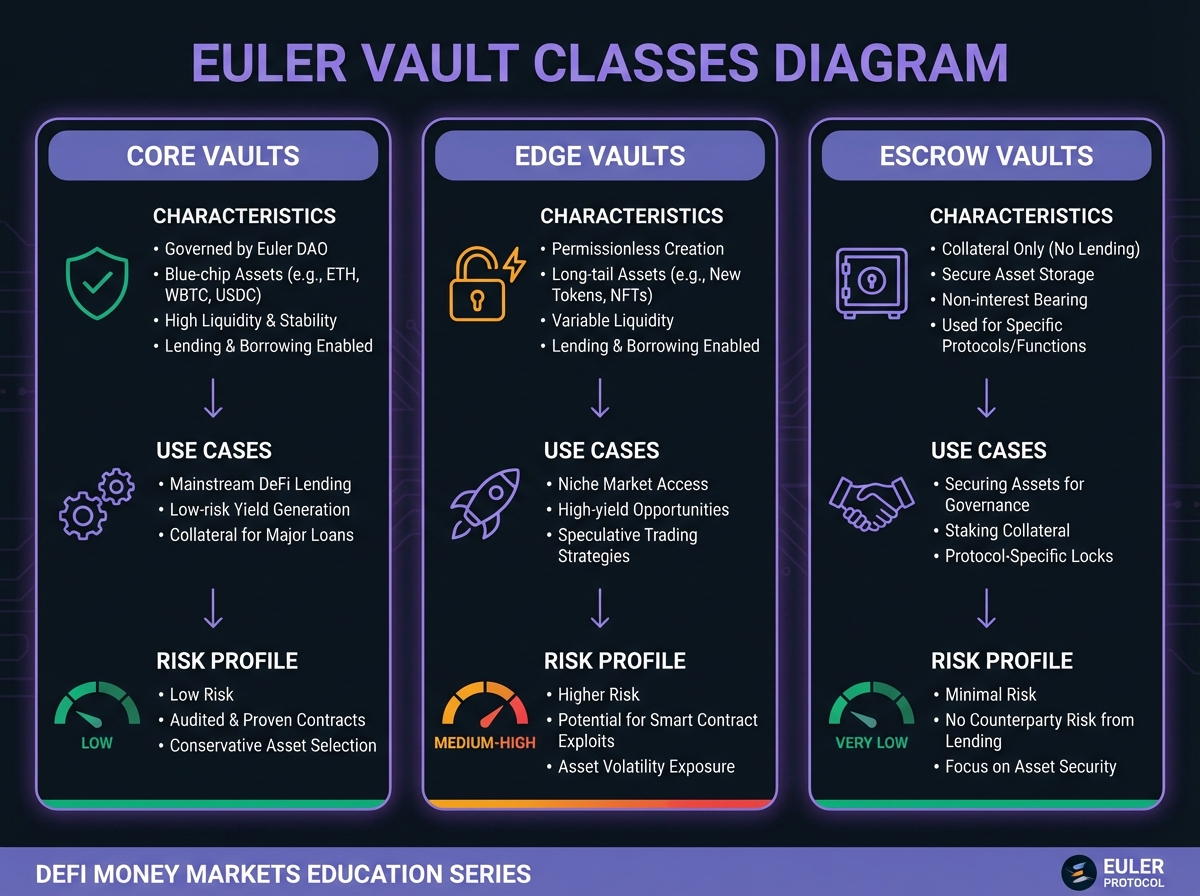
🎛️ Vault Classes: Risk Segmentation
Core Vaults
Characteristics:
- Governed by Euler DAO or high-reputation curators (Gauntlet)
- Blue-chip assets (USDC, WETH, WBTC)
- Reliable oracles (Chainlink)
- Cross-collateralization enabled
Best For: Institutional liquidity, conservative strategies
Edge Vaults
Characteristics:
- Permissionless, ungoverned
- Long-tail assets (meme coins, niche tokens)
- Custom oracle configurations
- Risk isolation (can't affect Core vaults)
Best For: Experimental strategies, high-risk tolerance
Escrow Vaults
Innovation: Accept assets as collateral but don't lend them out
Use Cases:
- Governance tokens (borrow without losing voting power)
- Rebasing tokens (complex transfer mechanics)
- Assets with no yield (need liquidity, not interest)
Result: Safe harbor for collateral types v1 couldn't support
🔒 Managed vs Trustless Vaults
Trustless Vaults
Characteristics:
- Immutable parameters (set at deployment)
- No curator control
- "Set and forget"
- Best for: Robust, well-understood pairs
Example: ETH/USDC vault with immutable 80% LTV, Chainlink oracle
Managed Vaults
Characteristics:
- Risk Curator can adjust parameters dynamically
- Can respond to changing volatility
- Best for: Newer assets with evolving risk profiles
Example: New memecoin vault with curator adjusting LTV based on volatility
🔐 Sub-Accounts: Granular Risk Isolation
How Sub-Accounts Work
The Innovation: Create virtually infinite sub-accounts under single wallet
Use Cases:
- Account A: Low-risk strategy (lending USDC only)
- Account B: High-risk strategy (borrowing against volatile tokens)
- Isolation: If Account B liquidated, Account A unaffected
Comparison: Superior to Aave's single-account model, offering Morpho-like isolation with Aave-like efficiency.
EulerSwap Integration
Feature: DEX integrated directly into lending interface
Capability: Seamless looping—swap USDC for ETH and deposit as collateral in single atomic transaction
Benefit: Convenience Risk: Encourages leverage—use with caution

🛡️ Oracle Freedom
Oracle Agnosticism
Unlike Aave: Not limited to Chainlink
Options:
- Chainlink (established, reliable)
- Pyth Network (high-frequency, low-latency)
- RedStone (on-demand updates)
- Custom oracles
Result: Can list long-tail assets Chainlink doesn't cover
⚠️ Operational Considerations
Verified vs Ungoverned Vaults
For Beginners: Stick to Verified/Governed vaults only
Why:
- Verified vaults have risk managers
- Can adjust parameters if conditions change
- Better documented and audited
Ungoverned Vaults:
- Immutable parameters
- No human intervention possible
- If flaw found in parameters, can't fix
- "Purely decentralized" but dangerous for beginners
Due Diligence Checklist
Before depositing into Euler vault:
- ✅ Is vault verified/governed or ungoverned?
- ✅ What's the curator's track record?
- ✅ What oracle does it use? Is it reliable?
- ✅ What are the LTV/risk parameters?
- ✅ Is there documentation/audit?
📊 Euler vs Competitors
| Feature | Aave | Morpho | Euler v2 |
|---|---|---|---|
| Architecture | Monolithic pools | Isolated markets | Modular vaults |
| Customization | Limited (governance) | Market parameters | Full vault control |
| Sub-Accounts | No | No | Yes |
| Oracle Choice | Primarily Chainlink | Oracle agnostic | Oracle agnostic |
| Vault Nesting | No | Limited | Yes (nested vaults) |
| Gas Efficiency | Medium | High | Medium-High |
🎯 When to Use Euler
Best For:
- ✅ Advanced users wanting customization
- ✅ Strategies requiring sub-accounts
- ✅ Long-tail assets not on other protocols
- ✅ Complex nested strategies
Not Ideal For:
- ❌ Beginners (start with Aave)
- ❌ Users wanting simplicity
- ❌ Those uncomfortable with vault selection
🚀 Getting Started with Euler
Step 1: Choose a Vault
For Beginners: Start with Core vaults (verified, governed)
- Standard USDC/ETH pairs
- Established curators
- Chainlink oracles
Step 2: Understand the Vault
- Check if verified or ungoverned
- Review curator documentation
- Understand risk parameters
- Check oracle reliability
Step 3: Use Sub-Accounts
- Create separate accounts for different strategies
- Isolate risk between positions
- Monitor each account independently
Step 4: Monitor
- Check vault parameters regularly
- Monitor curator updates (if managed)
- Review sub-account health factors
🎓 Beginner's Corner
Q: Is Euler safe after the v1 exploit? A: v2 is a complete rebuild with 31+ audits. Architecture fundamentally different (modular vs monolithic).
Q: Should I use ungoverned vaults? A: No, as a beginner. Stick to verified/managed vaults with curators.
Q: What are sub-accounts good for? A: Risk isolation. Keep high-risk and low-risk strategies separate.
🔬 Advanced Deep-Dive: Nested Vaults
How Nesting Works
Mechanism: Vault shares (ERC-20 tokens) can be deposited into other vaults
Example:
- Deposit USDC into Core USDC Vault → Receive eUSDC
- Deposit eUSDC into RWA Vault as collateral
- Borrow tokenized treasuries
Result: Recursive leverage and "fund of funds" structures natively supported.
📈 Real-World Example
Scenario: Using Euler sub-accounts for risk isolation
Account A (Conservative):
- Supply: $10,000 USDC
- Strategy: Earn yield only
- Risk: Low
Account B (Aggressive):
- Collateral: $5,000 ETH
- Borrowed: $3,000 USDC (60% LTV)
- Strategy: Trading
- Risk: High
Isolation: If Account B liquidated, Account A completely unaffected.
🔑 Key Takeaways
- Euler v2 is a complete rebuild after v1 exploit
- EVK + EVC enable highly customizable vaults
- Sub-accounts provide granular risk isolation
- Vault classes (Core/Edge/Escrow) segment risk
- Stick to verified vaults as a beginner
- Oracle freedom enables long-tail asset listing
🚀 Next Steps
Lesson 8 explores alternative chain protocols—Kamino (Solana), Suilend (Sui), and JustLend (Tron)—showing how high-performance chains handle money markets differently.
Complete Exercise 7 to practice Euler market creation and risk analysis.
Remember: Euler offers maximum customization but requires deep understanding. Master Aave and Morpho first, then explore Euler for advanced strategies.
← Back to Summary | Next: Exercise 7 → | Previous: Lesson 6 ←