Lesson 9: Yield Optimization Strategies
🎯 Core Concept: Maximizing Returns While Managing Risk
Yield optimization in money markets requires balancing multiple factors: supply rates, borrow costs, leverage, gas fees, and risk. This lesson teaches you to calculate true yields, execute looping strategies safely, and identify cross-protocol arbitrage opportunities.
📊 Supply Rate Maximization
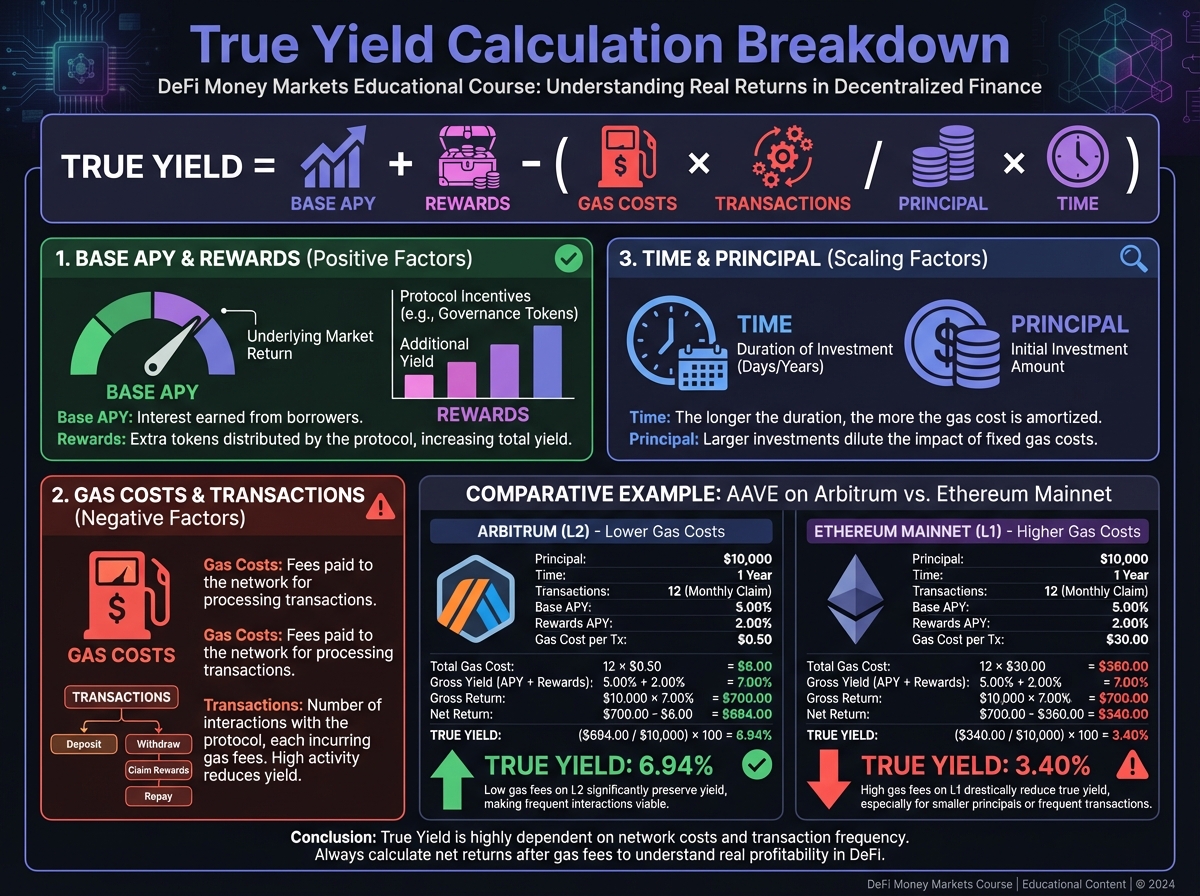
Understanding True Yield
Components of Yield:
- Base supply APY
- Protocol rewards (if applicable)
- Compounding frequency
- Gas costs (relative to position size)
True Yield Formula: $$True Yield = Base APY + Rewards - \frac{Gas Costs \times Transactions}{Principal \times Time}$$
Example:
- Base APY: 5%
- Gas per transaction: $0.50 (on L2)
- Transactions per year: 12 (monthly compounding)
- Principal: $10,000
- True yield: 5% - ($0.50 × 12) / $10,000 = 4.94%
Supply Rate Factors
1. Utilization Rate
- Higher utilization = higher supply rates
- Monitor utilization trends
- Move funds to higher-utilization pools when appropriate
2. Network Selection
- L2s (Arbitrum/Base): Lower gas, lower yields
- Mainnet: Higher gas, potentially higher yields
- Calculate break-even point based on position size
3. Stablecoin vs Crypto
- Stablecoins: Lower yields, lower risk
- Crypto: Higher yields (if used as collateral), higher risk
- Balance based on risk tolerance
💰 Borrow Rate Optimization
When Borrowing Makes Sense
1. Leverage Strategies
- Amplify yields on yield-bearing assets
- Example: Stake ETH (5% APY), borrow against it (4% cost) = 1% net + leverage
2. Arbitrage Opportunities
- Borrow low, lend high (different protocols)
- Example: Borrow USDC at 4% on Aave, lend at 6% on Morpho = 2% spread
3. Tax Efficiency
- Borrow against assets instead of selling
- Avoid taxable events
- Interest may be tax-deductible (consult tax professional)
Calculating Borrow Profitability
Net Yield Formula: $$Net Yield = (Asset Yield \times Leverage) - (Borrow Rate \times (Leverage - 1))$$
Example:
- Asset yield: 7% (JitoSOL staking)
- Leverage: 3x
- Borrow rate: 5%
- Net yield: (7% × 3) - (5% × 2) = 11% APY
Break-Even Point: $$Break-Even = \frac{Borrow Rate \times (Leverage - 1)}{Leverage}$$
If borrow rate exceeds this, position becomes unprofitable.
🔄 Looping Strategies
What is Looping?
Definition: Borrowing against collateral to buy more of the same asset, repeating the process to amplify exposure.
Steps:
- Deposit asset as collateral
- Borrow stablecoins
- Buy more of the asset
- Deposit as collateral
- Repeat
Manual Looping (Step-by-Step)
Example: Loop ETH position
Initial: 10 ETH @ $2,000 = $20,000
Iteration 1:
- Deposit 10 ETH (LTV 75%, max borrow $15,000)
- Borrow $10,000 USDC (conservative 50% of max)
- Buy 5 ETH with $10,000
- Total: 15 ETH collateral, $10,000 debt
Iteration 2:
- Deposit 5 new ETH (total 15 ETH)
- Borrow $5,000 USDC
- Buy 2.5 ETH
- Total: 17.5 ETH collateral, $15,000 debt
Result: 17.5 ETH exposure from initial 10 ETH (~1.75x leverage)
Automated Looping (Kamino Multiply)
Advantage: Atomic transactions—all steps in one block
How It Works:
- Protocol handles all steps automatically
- Flash loans eliminate intermediate capital needs
- Single transaction = lower gas + lower slippage risk
Example: JitoSOL Multiply
- Deposit 10 JitoSOL
- Set 3x leverage
- Protocol automatically loops
- Receive 3x exposure in single transaction
Loop Risk Management
Critical Rules:
- Monitor Health Factor: Keep HF > 2.0 minimum
- Calculate Break-Even: Know when position becomes unprofitable
- Set Stop-Loss: Define exit strategy before entering
- Start Small: Test with small positions first
- Understand Liquidation: Know exact liquidation price
Liquidation Price Formula: $$Liquidation Price = \frac{Debt}{Collateral \times LT}$$
Monitor constantly—loops amplify liquidation risk.

🌐 Cross-Protocol Arbitrage
Identifying Opportunities
Opportunities Arise When:
- Utilization differences across protocols
- Interest rate spreads
- Reward programs
- Temporary market inefficiencies
Example Scenario:
- Aave USDC supply: 4% APY
- Morpho USDC vault: 5.5% APY
- Spread: 1.5% APY
Strategy: Move funds from Aave to Morpho to capture spread.
Execution Considerations
1. Gas Costs
- Calculate if spread covers gas
- L2s reduce gas burden
- Minimum viable position size
2. Withdrawal Limits
- Check if immediate withdrawal possible
- Monitor idle liquidity on target protocol
- Have backup plan if withdrawal delayed
3. Risk Differences
- Understand protocol risk profiles
- Assess if extra yield compensates extra risk
- Consider insurance coverage differences

📈 Advanced Optimization Techniques
Compound Frequency Optimization
Understanding Compounding:
- More frequent compounding = higher effective yield
- But requires more transactions = more gas
Optimal Frequency:
- Small positions: Quarterly or annually
- Large positions ($50k+): Monthly or weekly
- Very large positions: Daily (if gas justified)
Formula: $$Effective APY = (1 + \frac{APY}{n})^n - 1$$
Where n = compounding frequency per year.
Multi-Protocol Diversification
Strategy: Split capital across multiple protocols
Benefits:
- Diversify protocol risk
- Capture best rates per protocol
- Avoid single point of failure
Example Allocation:
- 40% Aave (safety, insurance)
- 30% Morpho (efficiency)
- 20% Euler (customization)
- 10% Kamino (leverage strategies)
Yield Aggregators
What They Are: Protocols that automatically optimize across money markets
Examples: Yearn, Beefy, Convex
Pros:
- Automated optimization
- Gas-efficient rebalancing
- Professional management
Cons:
- Additional smart contract risk
- Fees (performance + management)
- Less control over strategy
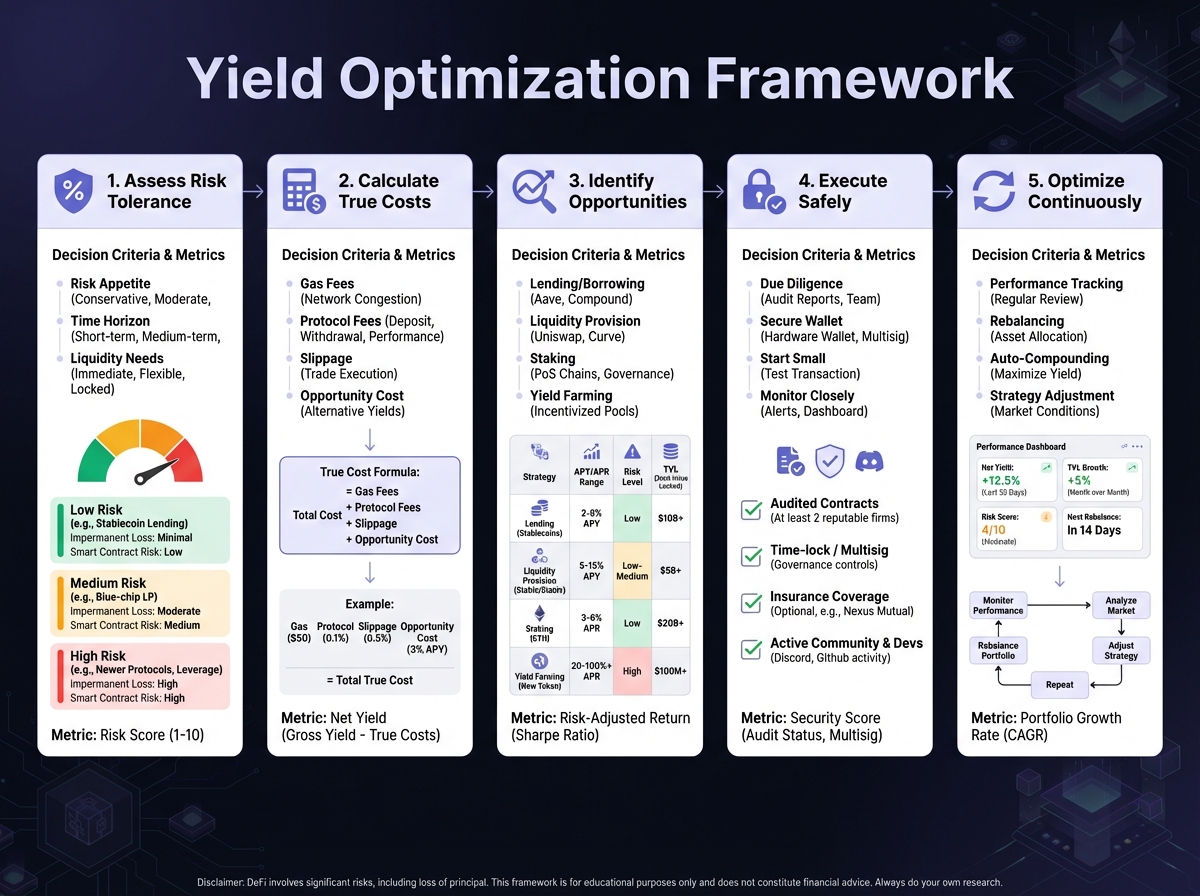
🎯 Yield Optimization Framework
Step 1: Assess Risk Tolerance
- Conservative: Supply stablecoins only, HF > 2.0
- Moderate: Some leverage (1.5-2x), blue-chip collateral
- Aggressive: Higher leverage, diversified protocols
Step 2: Calculate True Costs
- Base yields
- Gas costs
- Protocol fees
- Opportunity costs
Step 3: Identify Opportunities
- Monitor rate differences
- Track utilization changes
- Watch for reward programs
- Assess cross-protocol spreads
Step 4: Execute Safely
- Start small to test
- Monitor positions closely
- Have exit strategy
- Keep reserves for emergencies
Step 5: Optimize Continuously
- Review positions weekly
- Rebalance when spreads change
- Adjust for risk tolerance changes
- Track performance vs benchmarks
⚠️ Common Optimization Mistakes
Mistake 1: Chasing highest yield without considering risk
- Fix: Always assess risk-adjusted returns
Mistake 2: Ignoring gas costs
- Fix: Calculate true yield after fees
Mistake 3: Over-leveraging
- Fix: Keep HF > 2.0, understand liquidation risk
Mistake 4: Not monitoring positions
- Fix: Set up alerts, check daily
Mistake 5: Ignoring protocol differences
- Fix: Understand risk profiles, don't assume all protocols equal
📊 Real-World Optimization Example
Scenario: $50,000 to optimize
Option A: Aave only
- Supply USDC: 5% APY
- Annual earnings: $2,500
Option B: Diversified
- $20k Aave: 5% = $1,000
- $20k Morpho: 5.5% = $1,100
- $10k Kamino (2x leverage JitoSOL): 11% net = $1,100
- Total: $3,200
- Extra yield: $700 (28% improvement)
Risk: Higher (leverage + protocol diversification)
🔧 Interactive Tools
Interactive Looping Calculator
Calculate leverage, net yield, and break-even rates for looping strategies:

Launch Interest Accrual Simulator →
🔑 Key Takeaways
- True yield = Base APY + rewards - gas costs
- Looping amplifies returns but increases liquidation risk
- Cross-protocol arbitrage captures rate spreads
- Calculate break-even for all strategies
- Monitor constantly—rates and risks change
- Start conservative—optimize incrementally
🚀 Next Steps
Lesson 10 explores advanced risk management and hedging strategies—protecting positions during volatility, managing multi-protocol portfolios, and building comprehensive risk frameworks.
Complete Exercise 9 to build your yield optimization framework.
Remember: Optimization is about maximizing risk-adjusted returns, not just raw yield. Balance efficiency with safety.
← Back to Summary | Next: Exercise 9 → | Previous: Lesson 8 ←