Lesson 10: Risk Management and Hedging
🎯 Core Concept: Professional Risk Management
Advanced risk management goes beyond monitoring Health Factor. This lesson teaches portfolio diversification, liquidation protection systems, hedging strategies, and building comprehensive risk frameworks for multi-protocol operations.
📊 Portfolio Diversification
Multi-Protocol Strategy
Why Diversify:
- Protocol-specific risks (bugs, governance attacks)
- Liquidity fragmentation
- Rate volatility differences
- Insurance coverage variations
Diversification Framework:
By Protocol:
- 40-50% Aave (safety, insurance)
- 20-30% Morpho (efficiency)
- 10-20% Euler (customization)
- 10-20% Alternative chains (yield)
By Asset:
- Stablecoins: 50-60% (base yield)
- Blue-chip crypto: 30-40% (growth + yield)
- Yield-bearing tokens: 10-20% (optimization)
By Strategy:
- Supply only: 60-70% (low risk)
- Moderate leverage: 20-30% (optimization)
- Aggressive strategies: 10-20% (maximum yield)
Correlation Analysis
Understanding Correlation:
- Assets that move together amplify risk
- Diversification reduces impact of single asset failure
Example Portfolio:
- USDC (stable)
- ETH (volatile, uncorrelated with stablecoins)
- BTC (volatile, correlated with ETH but different magnitude)
- LSTs (correlated with ETH but with staking yield)
Risk: If crypto crashes together, crypto-collateralized positions all at risk.

🛡️ Liquidation Protection Strategies
Health Factor Monitoring Systems
Automated Alerts:
- Set HF threshold alerts (e.g., alert if HF < 1.8)
- Price movement alerts for collateral
- Utilization spike alerts (affects rates)
- Protocol pause/incident alerts
Tools:
- DeFi portfolio trackers (Zapper, DeBank)
- Custom scripts (webhooks + Discord/Telegram)
- Protocol-specific dashboards
- Price alert services (CoinGecko, etc.)
Dynamic Collateral Management
Strategy 1: Maintain Reserve Fund
- Keep 20-30% of capital in stablecoins outside positions
- Use to add collateral if HF drops
- Provides buffer during volatility
Strategy 2: Multiple Collateral Types
- Don't rely on single collateral
- Diversify across asset classes
- If one crashes, others may hold
Strategy 3: Conservative LTV
- Borrow only 40-50% of max LTV
- Maintain larger safety buffer
- Reduces need for constant monitoring
Automated Protection Mechanisms
1. Keep3r/Chainlink Automation:
- Automatically add collateral if HF drops
- Requires gas funds in reserve
- Set threshold triggers
2. Protocol-Specific Features:
- Aave: Safety module insurance
- Kamino: Auto-Deleverage
- Some protocols: Partial liquidation protection
3. Smart Contract Safeguards:
- Set max borrow limits
- Automatic position reduction at thresholds
- Flash loan protection
🔄 Hedging Strategies
Understanding Hedging
Definition: Taking offsetting positions to reduce risk
Goal: Limit downside while maintaining upside potential
Common Hedging Techniques
1. Stablecoin Hedging
- Borrow against volatile collateral
- Hold borrowed stablecoins as hedge
- If collateral crashes, stablecoins preserve value
Example:
- Collateral: 10 ETH @ $2,000 = $20,000
- Borrow: $10,000 USDC (hold as reserve)
- If ETH drops 50%: Collateral = $10,000, debt = $10,000
- Net position: $0 loss (instead of -$10,000)
2. Options Hedging (Advanced)
- Buy put options on collateral
- Limits downside exposure
- Cost: Premium payments
3. Futures Hedging
- Short futures against collateral
- Offsets price movements
- Requires active management

Partial Hedging
Strategy: Hedge portion of position
Example:
- Position: $20,000 ETH collateral, $10,000 debt
- Hedge: Short $5,000 ETH futures
- Result: 50% hedged, 50% exposed
Balance: Maintains upside potential while limiting downside.
🏗️ Risk Management Framework
Risk Assessment Matrix
Evaluate Each Position:
| Factor | Score (1-5) | Weight | Weighted Score |
|---|---|---|---|
| Protocol Risk | ___ | 30% | ___ |
| Collateral Volatility | ___ | 25% | ___ |
| Health Factor | ___ | 20% | ___ |
| Liquidity Risk | ___ | 15% | ___ |
| Oracle Risk | ___ | 10% | ___ |
| Total Risk Score | ___ |
Risk Thresholds:
- < 2.0: Low risk (acceptable)
- 2.0-3.0: Moderate risk (monitor closely)
-
3.0: High risk (reduce or exit)
Position Sizing Framework
Kelly Criterion (Simplified): $$Position Size = \frac{Edge}{Odds}$$
For Money Markets:
- Edge = Expected yield advantage
- Odds = Risk of loss
Conservative Approach: Use fractional Kelly (50% of calculated size)
Example:
- Expected edge: 2% APY advantage
- Risk of loss: 5% (liquidation + protocol risk)
- Position size: (0.02 / 0.05) × 0.5 = 20% of capital
Stress Testing
Scenario Analysis:
- Base Case: Expected outcomes
- Stress Case: 30% collateral drop
- Extreme Case: 50% drop + protocol pause
For Each Scenario:
- Calculate new Health Factor
- Assess liquidity availability
- Evaluate exit options
- Calculate potential losses
Action Plan: Define responses for each scenario before they occur.

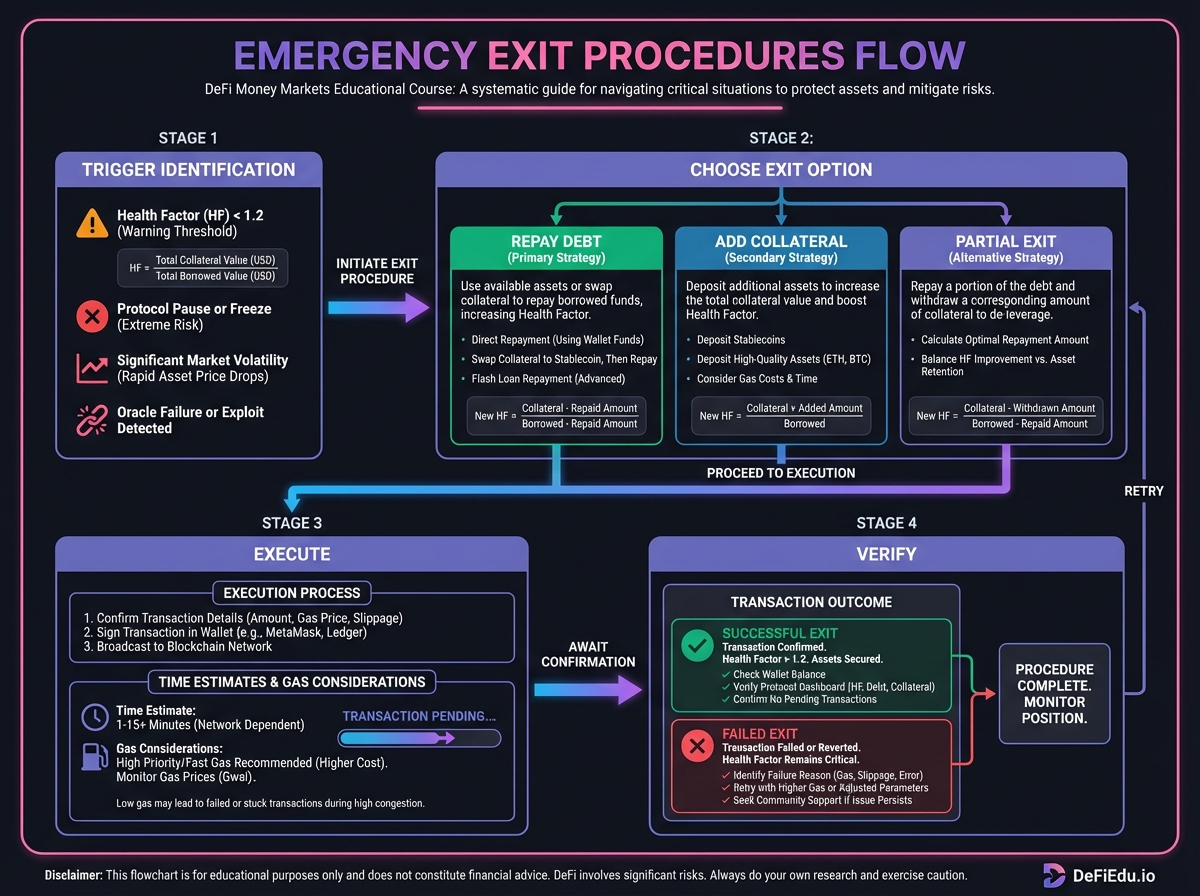
🚨 Emergency Exit Procedures
When to Exit
Triggers:
- HF < 1.2 (critical)
- Protocol pause/exploit announced
- Oracle failure detected
- Critical collateral depeg
- Major market crash (>30% in 24h)
Exit Execution
Option 1: Repay Debt
- Calculate total debt (principal + interest)
- Ensure funds available (reserve fund)
- Repay via protocol interface
- Withdraw collateral
- Time: Minutes (depends on network)
Option 2: Add Collateral
- Calculate required collateral
- Transfer additional assets
- Deposit to increase HF
- Time: Fastest option if reserves available
Option 3: Partial Exit
- Repay portion of debt
- Withdraw some collateral
- Maintain smaller position
- Time: Intermediate strategy
Exit Timing
Consider:
- Gas costs vs position value
- Network congestion (delays during volatility)
- Price slippage if swapping
- Time to execute full exit
Preparation: Keep gas tokens ready, have exit plan documented.
📈 Risk-Adjusted Returns
Sharpe Ratio (Simplified)
Formula: $$Sharpe = \frac{Return - Risk Free Rate}{Volatility}$$
For Money Markets:
- Return = Net APY earned
- Risk-free rate = Stable supply rate (e.g., 4%)
- Volatility = Standard deviation of returns
Interpretation:
-
1.0: Good risk-adjusted returns
- 1.0-2.0: Very good
-
2.0: Excellent
Sortino Ratio
Focus: Downside volatility only (more relevant for lending)
Formula: $$Sortino = \frac{Return - Risk Free Rate}{Downside Deviation}$$
Benefit: Doesn't penalize positive volatility (upside gains).
🎯 Risk Management Best Practices
Daily Practices
- Check Health Factors on all positions
- Review collateral prices (any significant moves?)
- Monitor protocol news/updates
- Check utilization rates (affects yields)
- Review any alerts/notifications
Weekly Practices
- Calculate risk scores for all positions
- Review portfolio allocation
- Assess any new opportunities
- Update exit plans if needed
- Review performance vs targets
Monthly Practices
- Comprehensive portfolio review
- Stress test all positions
- Rebalance if needed
- Update risk framework
- Document lessons learned
🎓 Beginner's Corner
Q: How much should I hedge? A: Start with 0% hedging. As you scale, consider 20-30% partial hedging on large positions.
Q: What's the minimum HF to maintain? A: 2.0 absolute minimum. Consider 2.5+ for peace of mind.
Q: Should I diversify across many protocols? A: Start with 2-3 reputable protocols. Too many = harder to monitor.
Q: How often should I check positions? A: Daily during active positions. Weekly if supply-only conservative strategies.
🔬 Advanced Deep-Dive: Correlation Hedging
Portfolio Correlation Matrix
Calculate correlations:
- ETH vs BTC: High (0.7-0.9)
- ETH vs Stablecoins: Low (0.1-0.3)
- BTC vs Stablecoins: Low (0.1-0.3)
Hedging Strategy:
- If holding ETH collateral, diversify with stablecoin positions
- Avoid over-concentration in correlated assets
- Use uncorrelated assets to reduce portfolio risk
📊 Real-World Example: Risk Management
Portfolio:
- $50k total capital
Allocation:
- $25k Aave: USDC supply (HF: N/A, risk: low)
- $15k Morpho: ETH collateral, $7.5k USDC borrowed (HF: 2.5, risk: moderate)
- $10k reserve: USDC (emergency fund)
Risk Assessment:
- Protocol risk: Diversified (low)
- Collateral risk: ETH only (moderate)
- Health Factor: 2.5 (safe)
- Liquidity: Reserve fund available (low risk)
Action Plan:
- Daily: Check Morpho HF
- If HF < 2.0: Add collateral from reserve
- If HF < 1.5: Repay $2.5k debt
- If protocol issues: Exit immediately
Interactive Risk Assessment Checklist
Evaluate your position's risk profile before entering:

🔑 Key Takeaways
- Diversify across protocols, assets, and strategies
- Monitor Health Factors daily with automated alerts
- Maintain reserves for emergency collateral additions
- Hedge selectively to limit downside while maintaining upside
- Stress test positions regularly
- Have exit plans documented before emergencies
🚀 Next Steps
Lesson 11 explores advanced topics and emerging trends—RWAs, institutional adoption, governance participation, and the future of money markets.
Complete Exercise 10 to design your risk management framework.
Remember: Risk management is about protecting capital first, optimizing returns second. Better to earn 4% safely than 8% with high liquidation risk.
← Back to Summary | Next: Exercise 10 → | Previous: Lesson 9 ←