Lesson 8: Alternative Chain Protocols
🎯 Core Concept: High-Performance Chain Money Markets
While Ethereum-based protocols focus on modularity and L2 scaling, high-performance chains (Solana, Sui, Tron) prioritize speed, capital efficiency, and user experience. This lesson explores Kamino (Solana), Suilend (Sui), and JustLend (Tron)—each optimized for their network's unique capabilities.
🪐 Kamino Finance (Solana)
The Hybrid Primitive
Key Innovation: Unifies lending markets with automated liquidity vaults into a single hybrid primitive. Users earn both trading fees (as LPs) and interest (as lenders) simultaneously.
Architecture:
- Vault Layer: Automated CLMM (Concentrated Liquidity Market Maker) positions
- Lending Layer (K-Lend): Accepts LP tokens (kTokens) as collateral
- Result: Capital efficiency—deposit into LP, use LP tokens as collateral to borrow
The Multiply Product
What It Is: One-click leverage engine automating looping strategies
How It Works (Atomic Transaction):
- Flash loan initiation
- Asset swap via Jupiter aggregator
- Collateral deposit
- Debt creation
- Flash loan repayment
Example: JitoSOL Multiply vault
- User deposits JitoSOL
- Protocol borrows SOL → swaps for JitoSOL → deposits → repeats
- Amplifies staking yield (7% base → ~13% with 3x leverage)
The Risk: Negative Net APY—if borrow rate exceeds staking yield, position costs money. Monitor constantly.

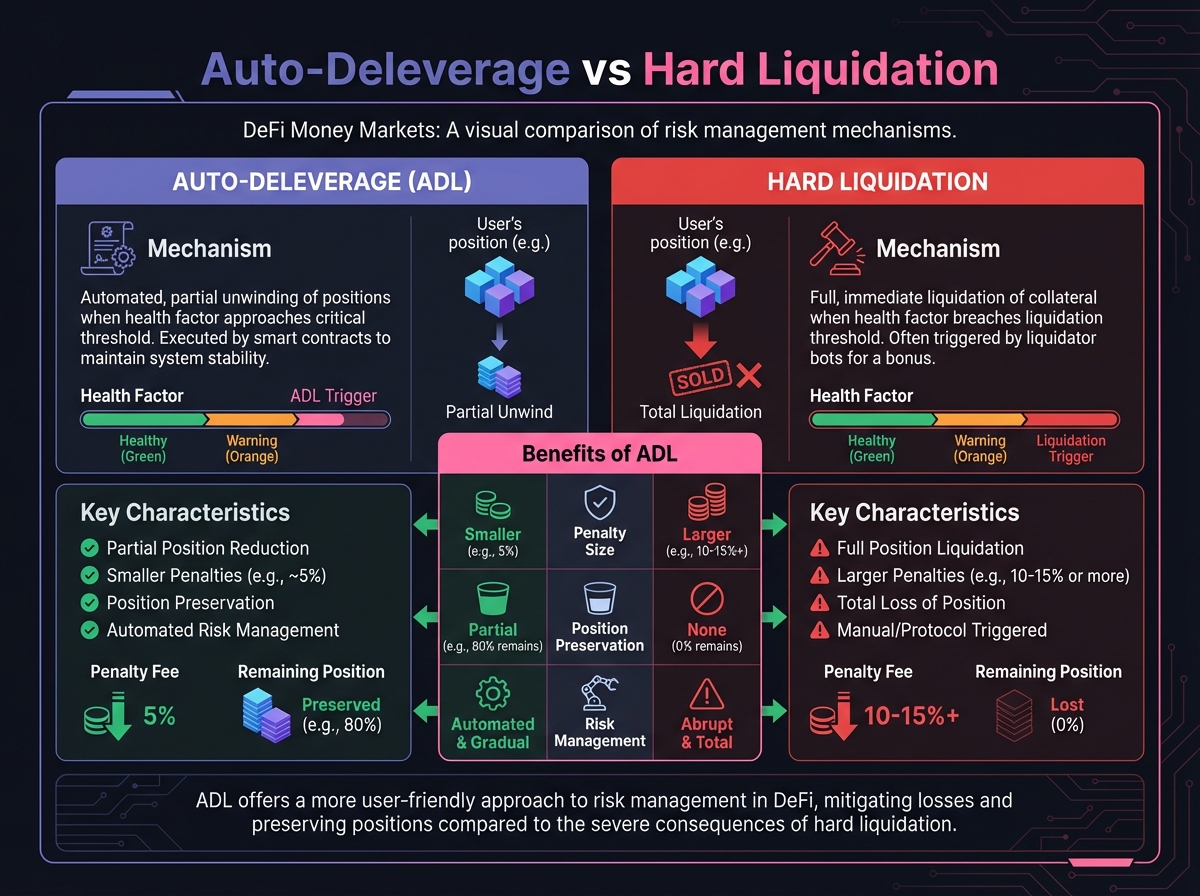
Auto-Deleverage (ADL)
Innovation: Prevents catastrophic liquidations
How It Works:
- Monitors position health
- As it approaches danger, partially unwinds
- Sells just enough collateral to restore health
- Avoids total loss scenario
Benefit: Automated risk manager—superior to hard liquidations
V2 Modular Design
Market Factory Model:
- Permissionless market creation
- Isolated markets (like Morpho)
- Risk isolation at market level
- Custom oracle configurations
Result: Can list any SPL token, including meme coins, with isolated risk.
🌊 Suilend (Sui)
The Move-Based Architecture
Built By: Team behind Solend (Solana's first money market)
Language: Move (asset-safe programming language)
- Treats tokens as objects (not mutable ledger entries)
- Built-in security for asset transfers
- Designed for high-performance DeFi
Operational Considerations
Bridging:
- Use Sui Bridge (native) or Portal (Wormhole)
- Critical: Bridge canonical assets (native USDC, not wUSDC)
- Verify asset version before depositing
Strategies:
- Similar to Kamino—automated rebalancing
- Sui-specific optimizations
- Move language security benefits
Security History
May 2025 Incident:
- $10M exploit in isolated asset pools
- Main pools remained safe
- Lesson: Avoid isolated/experimental pools until ecosystem matures
Recommendation: Stick to Main Pool assets (SUI, USDC, USDT) for safety.
🌐 JustLend (Tron)
The Tron Ecosystem Leader
TVL: Often exceeds $6-8 billion
- Massive financial engine
- Unique risk profile (centralization + algorithmic stablecoins)
The USDD Factor
Core Asset: USDD stablecoin
- Algorithmic stablecoin (claims over-collateralization)
- Rating: "F" (Failing) by Bluechip stablecoin rating agency
- Concerns: Governance and reserve composition transparency
The Yield Trap:
- High APYs (10-30% via mining rewards)
- Risk premium—you're paid to take USDD depeg risk
- Warning: Avoid significant holdings in USDD or using as collateral
Why: If USDD depegs, liquidation engine could trigger spiral affecting entire system.
Energy and Bandwidth Model
Unique Fee Structure:
- Tron uses "Energy" and "Bandwidth" (not just gas)
- Executing smart contracts requires Energy
- Cost: 10-20 TRX ($2-4) per interaction if Energy not frozen (staked)
For Beginners: Freeze TRX to generate Energy, or costs will drain wallet unexpectedly.
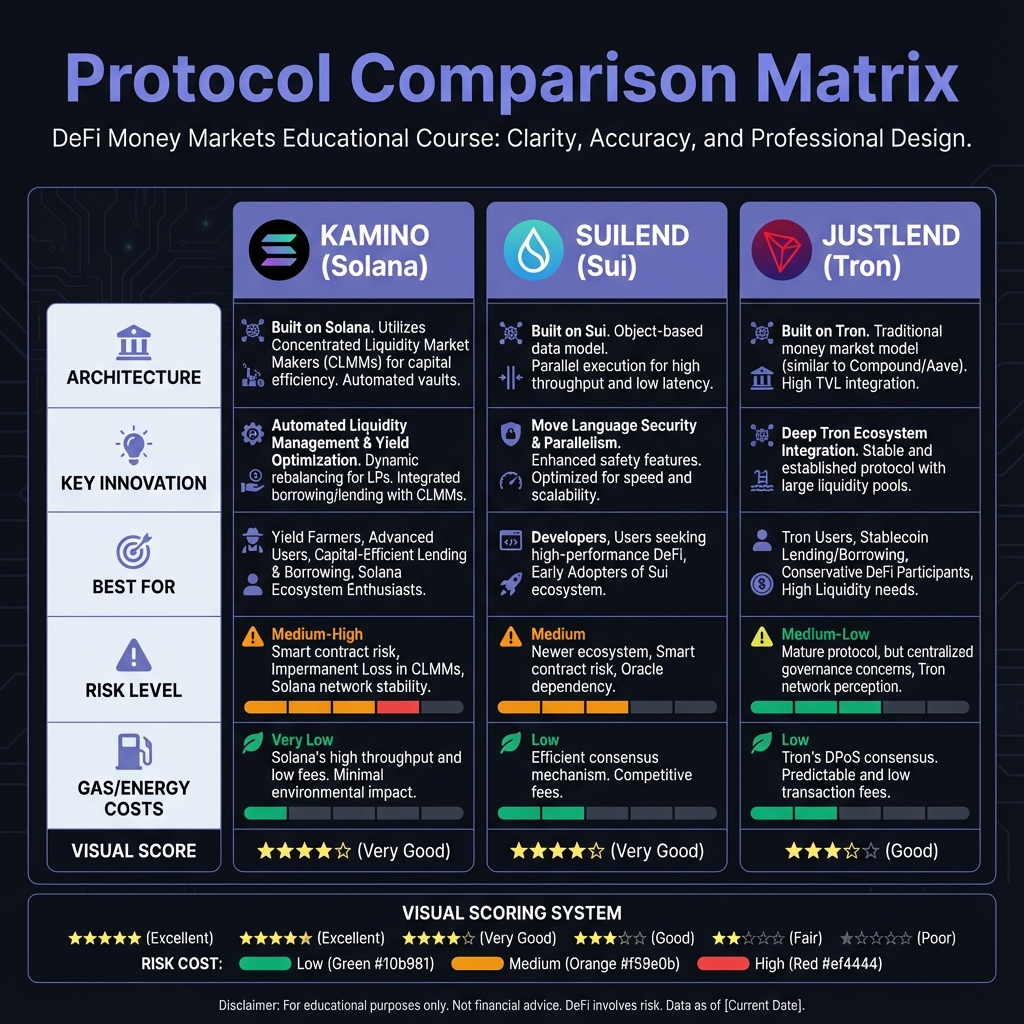
📊 Cross-Chain Comparison
| Feature | Kamino (Solana) | Suilend (Sui) | JustLend (Tron) |
|---|---|---|---|
| Architecture | Hybrid (Lending + LP) | Monolithic | Monolithic |
| Key Innovation | Multiply + ADL | Move security | High yields |
| Best For | Leverage strategies | Move-native assets | Tron ecosystem |
| Risk Level | Medium | Medium | High (USDD) |
| Gas Costs | Very low | Very low | Energy model |
⚠️ Cross-Chain Considerations
Bridge Risk
The Problem: Moving assets between chains introduces new risks
Risks:
- Bridge hacks
- Asset wrapping (canonical vs bridged)
- Liquidity fragmentation
Best Practices:
- Use official/canonical bridges
- Verify asset version (native vs wrapped)
- Bridge small amounts first to test
- Keep native gas tokens for destination chain
Canonical Assets
Critical: Verify you're using canonical (official) versions
Example:
- Sui: Native USDC (Circle-issued) vs wUSDC (Wormhole-wrapped)
- Suilend prioritizes native USDC
- Using wrong version = fragmented liquidity + depeg risk
Always Check: Protocol documentation for supported asset versions

🎯 When to Use Alternative Chains
Use Solana (Kamino) For:
- ✅ High-speed transactions
- ✅ Leverage strategies (Multiply)
- ✅ Capital efficiency (LP + lending combo)
- ✅ Low fees
Use Sui (Suilend) For:
- ✅ Move-native assets
- ✅ Move language security benefits
- ✅ Sui ecosystem integration
- ✅ Main pool assets (SUI, USDC, USDT)
Use Tron (JustLend) For:
- ✅ Tron ecosystem native
- ⚠️ High yields (but understand USDD risks)
- ⚠️ Accept centralization risk
🚀 Getting Started on Alternative Chains
Step 1: Network Setup
- Install wallet (Phantom for Solana, Sui Wallet, TronLink)
- Fund wallet with native token (SOL, SUI, TRX)
- Bridge assets if coming from another chain
- Verify canonical assets
Step 2: Choose Protocol
- Solana: Kamino (dominant money market)
- Sui: Suilend (established, secure)
- Tron: JustLend (only major option)
Step 3: Start Conservative
- Avoid isolated/experimental pools initially
- Stick to main pool assets
- Understand gas/energy model
- Monitor positions actively
Step 4: Understand Risks
- Bridge risks (canonical assets)
- Network-specific risks (USDD on Tron)
- Auto-deleverage benefits (Kamino)
- Move security model (Sui)
🎓 Beginner's Corner
Q: Should I use alternative chains? A: Start on Ethereum L2s (Aave on Arbitrum). Explore alt chains after mastering basics.
Q: Is USDD safe? A: No. It has an "F" rating. Avoid significant exposure.
Q: Why use Solana/Sui over Ethereum? A: Speed and low fees are advantages, but Ethereum L2s offer similar benefits with more liquidity.
Q: What about bridge risks? A: Always use official bridges. Verify canonical assets. Start small to test.
🔬 Advanced Deep-Dive: Kamino's Efficiency
Why Hybrid Primitive Matters
Traditional DeFi:
- Choose: LP fees OR lending interest
- Capital siloed
Kamino:
- LP tokens as collateral
- Earn fees + interest simultaneously
- Double capital utility
Example:
- Deposit $100k into SOL/USDC LP
- Earn trading fees: 10% APY
- Use kToken as collateral, borrow $50k USDC
- Deploy $50k in another strategy
- Total utility: 1.5x capital efficiency
📈 Real-World Example: Kamino Multiply
Setup:
- Deposit: 10 JitoSOL (worth $2,000)
- Target: 3x leverage
- Base yield: 7% APY
- Borrow cost: 4% APY
Calculation:
- Effective yield: (7% × 3) - (4% × 2) = 13% APY
- If borrow cost spikes to 8%: (7% × 3) - (8% × 2) = 5% APY
- If borrow cost exceeds staking yield: Negative APY
Monitor: Net APY constantly to avoid losses.
🔑 Key Takeaways
- Kamino offers hybrid primitive (LP + lending) with Multiply leverage
- Suilend leverages Move language security
- JustLend dominates Tron but carries USDD risk
- Bridge risks are real—use canonical assets
- Auto-Deleverage (Kamino) prevents catastrophic liquidations
- Start on Ethereum L2s before exploring alternative chains
🚀 Next Steps
Lesson 9 explores yield optimization strategies—maximizing returns while managing risk through looping, cross-protocol arbitrage, and strategic position sizing.
Complete Exercise 8 to practice multi-protocol comparison and selection.
Remember: Alternative chains offer speed and efficiency but require understanding network-specific risks. Master Ethereum-based protocols first, then explore with small positions.
← Back to Summary | Next: Exercise 8 → | Previous: Lesson 7 ←