Lesson 2: The Mathematics of Liquidity Provision
🎯 Core Concept: Math is Your Protection
Understanding the mathematics behind AMMs isn't just academic—it's your primary defense against losses. The formulas determine:
- How much you'll receive when swapping
- What price impact your trade will have
- How fees are calculated and distributed
- Why impermanent loss occurs
Master these calculations, and you'll make better decisions, avoid costly mistakes, and optimize your returns.
📐 The Constant Product Formula: Deep Dive
The Fundamental Equation
$$x \cdot y = k$$
This simple equation governs every trade in a constant product AMM. Let's break it down:
Variables:
- x: Reserve of token X (e.g., ETH)
- y: Reserve of token Y (e.g., USDC)
- k: Constant product (must remain unchanged after fees)
Rule: After any trade (excluding fees), x × y must equal k.
Calculating Swap Amounts
When you want to swap Δx tokens of X for tokens of Y:
Without fees: $$(x + \Delta x) \cdot (y - \Delta y) = k$$
With fees (fee rate φ, e.g., 0.003 for 0.3%): $$(x + \Delta x \cdot (1 - \phi)) \cdot (y - \Delta y) = k$$
The fee is deducted from the input amount before the swap calculation.
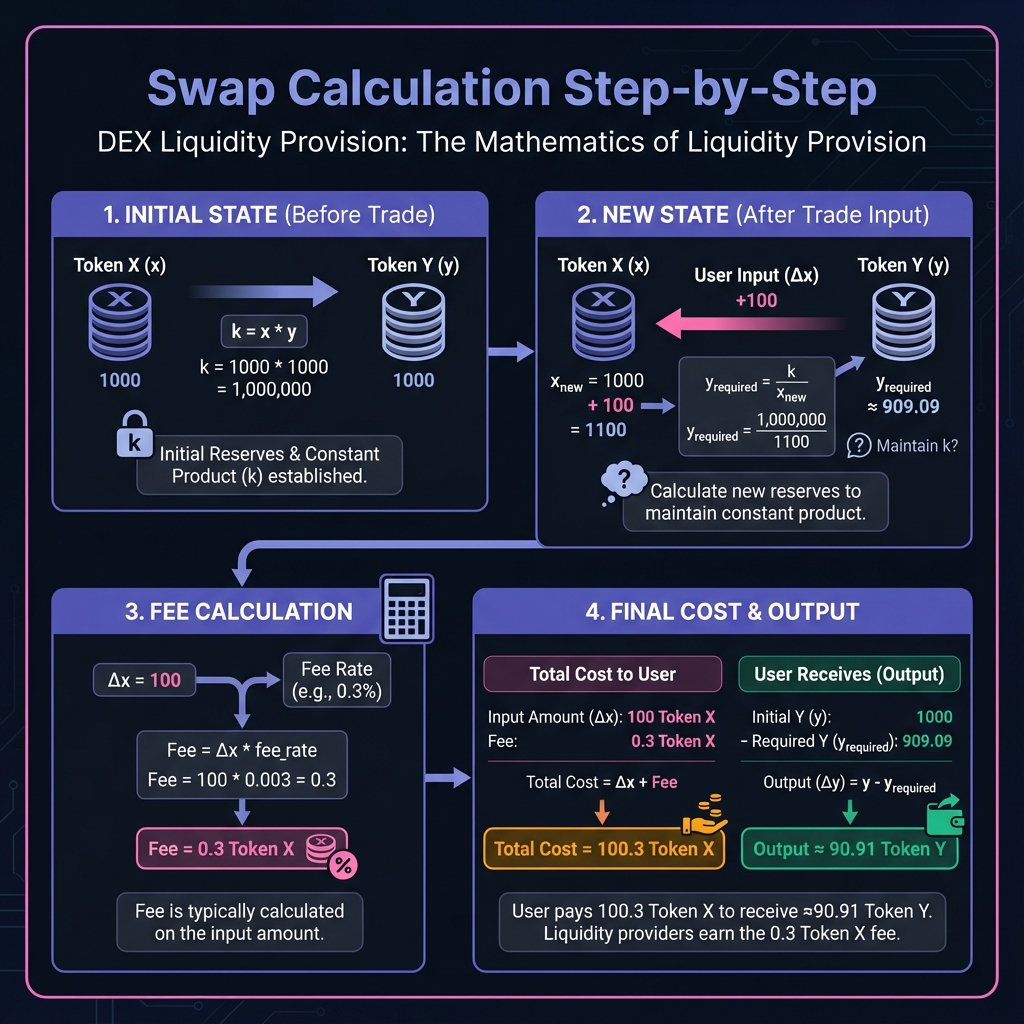
Step-by-Step Calculation
Example: Pool has 10 ETH (x) and 20,000 USDC (y)
- k = 10 × 20,000 = 200,000
- Fee rate: 0.3% (φ = 0.003)
- You want to buy 1 ETH with USDC
Step 1: Calculate new x after your trade
- x_new = 10 + 1 = 11 ETH
Step 2: Calculate required y to maintain k
- y_new = k ÷ x_new = 200,000 ÷ 11 = 18,181.82 USDC
Step 3: Calculate how much USDC you need to deposit
- Δy = 20,000 - 18,181.82 = 1,818.18 USDC
Step 4: Add fee (0.3% of input)
- Fee = 1,818.18 × 0.003 = 5.45 USDC
- Total you pay = 1,818.18 + 5.45 = 1,823.63 USDC
Result: You pay 1,823.63 USDC to receive 1 ETH
- Effective price: 1,823.63 USDC per ETH
- Original price: 2,000 USDC per ETH
- Price impact: (1,823.63 - 2,000) ÷ 2,000 = -8.8%
Price Impact Formula
The larger your trade relative to the pool, the more price impact:
$$\text{Price Impact} = \frac{\Delta x}{x} \times 100%$$
For the example above:
- Δx = 1 ETH, x = 10 ETH
- Price impact ≈ 10% (simplified calculation)
Key Insight: Trade size matters. A $100,000 trade in a $1M pool will have significant impact. A $100 trade in the same pool will have minimal impact.
📊 Understanding Price Curves
The Hyperbolic Price Curve
The constant product formula creates a hyperbolic price curve:
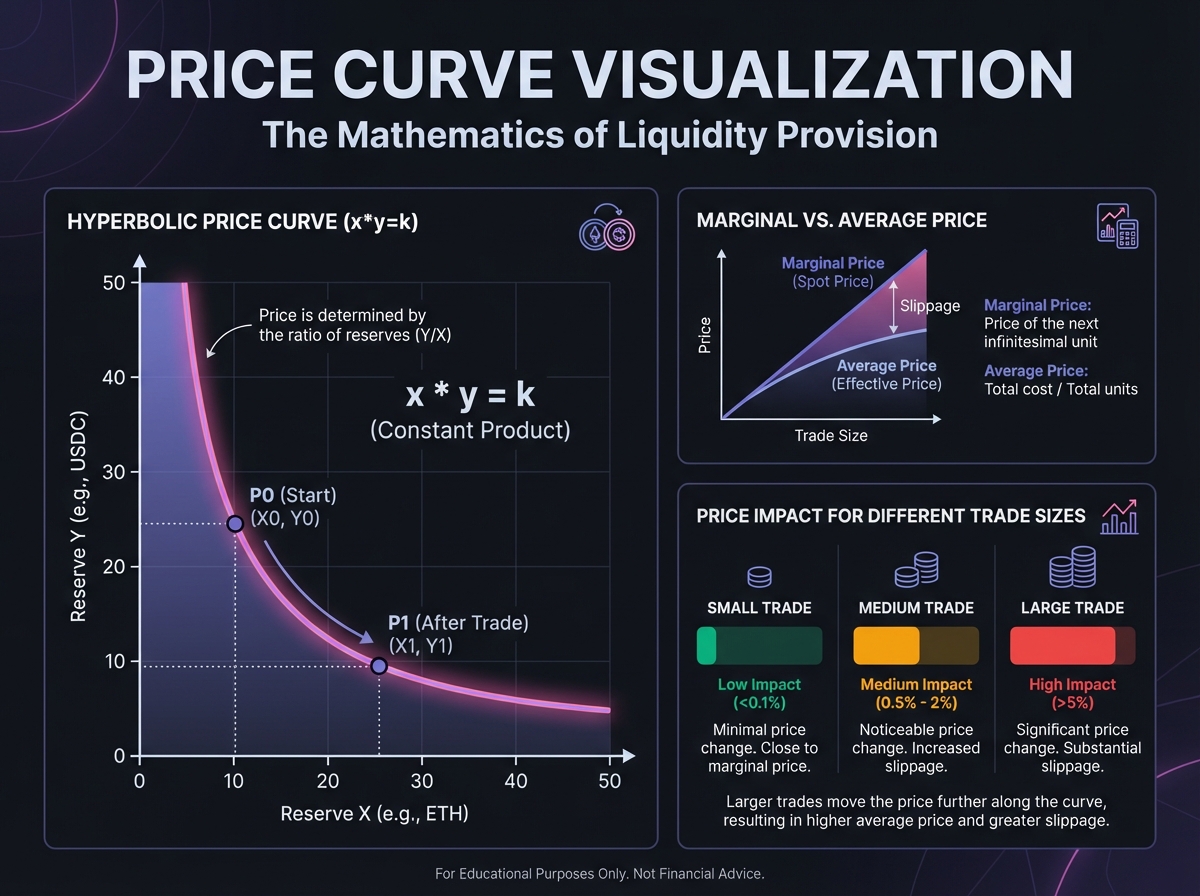
Characteristics:
- As x approaches 0, price approaches infinity
- As y approaches 0, price approaches 0
- The curve is always decreasing (more X = lower price of X)
- Price changes smoothly with each trade
Price Calculation
The current price of token X in terms of token Y:
$$P = \frac{y}{x}$$
Example:
- Pool: 10 ETH, 20,000 USDC
- Price: 20,000 ÷ 10 = 2,000 USDC per ETH
After buying 1 ETH:
- Pool: 11 ETH, 18,181.82 USDC
- New price: 18,181.82 ÷ 11 = 1,653 USDC per ETH
The price moved down because ETH supply increased (you added ETH to the pool by buying it).
Marginal Price vs. Average Price
Marginal Price: The price for the next infinitesimal trade
- Formula: P = y/x
- This is what you see on interfaces
Average Price: The price you actually pay for your trade
- Formula: (Total USDC paid) ÷ (ETH received)
- Always worse than marginal price due to slippage
Example:
- Marginal price: 2,000 USDC/ETH
- You buy 1 ETH for 1,823.63 USDC
- Average price: 1,823.63 USDC/ETH
- Difference: 176.37 USDC (8.8% worse)
💧 Liquidity Depth and Capital Efficiency
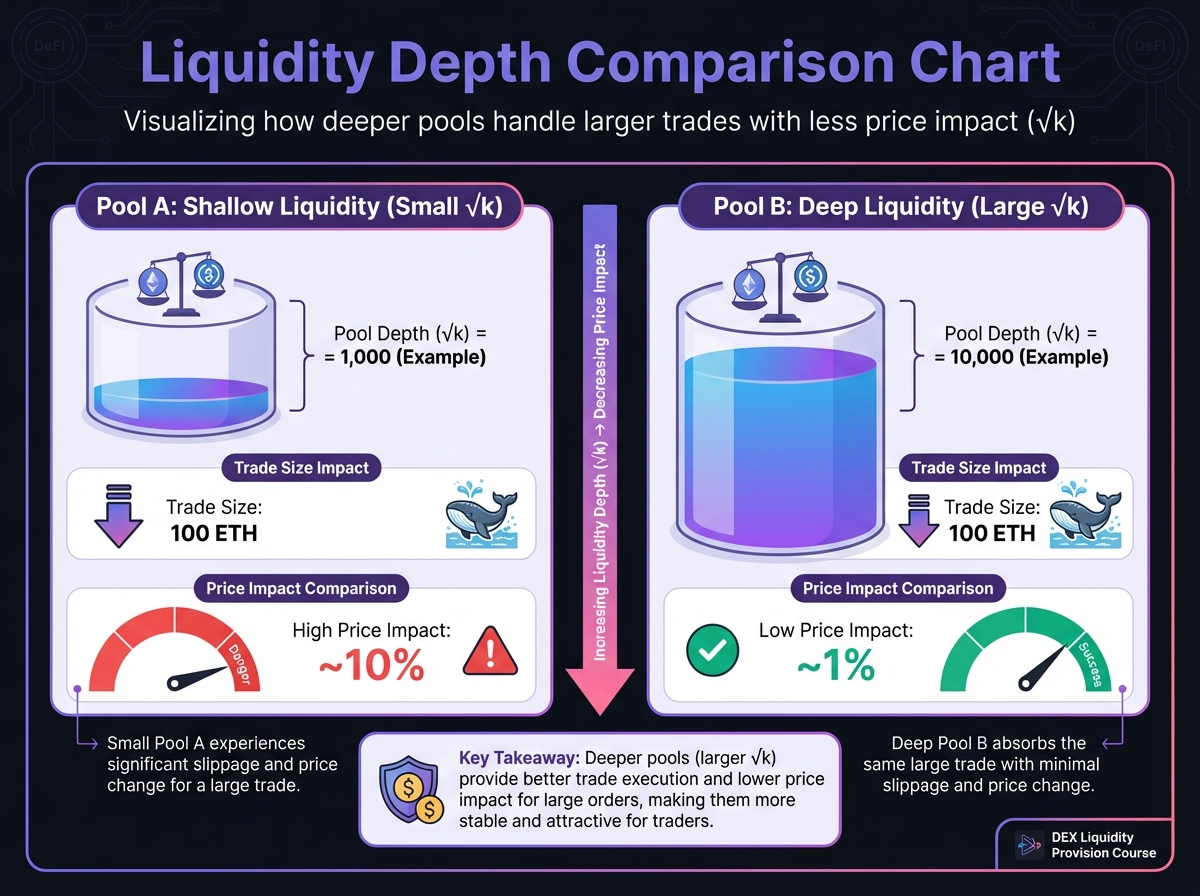
Measuring Pool Depth
Pool depth determines how much you can trade before significant price impact:
$$D = \sqrt{x \cdot y} = \sqrt{k}$$
Deeper pools (larger k):
- Can handle larger trades
- Less price impact per trade
- More stable prices
Shallow pools (smaller k):
- Large trades cause significant slippage
- Prices move dramatically
- Higher risk for LPs
Capital Efficiency Problem
In Uniswap V2, liquidity is distributed across the entire price curve (0 to ∞). For a stablecoin pair trading at $1.00:
- 99.9% of liquidity sits at prices like $0.01 or $100.00
- Only 0.1% is active near the current price
- This means 99.9% of capital earns no fees
Example:
- Pool: 1,000,000 USDC + 1,000,000 DAI (trading at 1:1)
- Active liquidity: ~$2,000 (0.1% of $2M)
- Idle liquidity: $1,998,000 (99.9%)
This inefficiency led to Uniswap V3's concentrated liquidity (Lesson 5).
🧮 Fee Mathematics
How Fees Accumulate
Fees are added to the pool, increasing the value of LP tokens:
Before trade:
- Pool: 10 ETH, 20,000 USDC
- Your share: 10% (1 ETH, 2,000 USDC)
Trade occurs: Someone swaps 1 ETH for 1,823.63 USDC
- Fee: 5.45 USDC added to pool
- New pool: 11 ETH, 18,181.82 + 5.45 = 18,187.27 USDC
- Pool value increased by 5.45 USDC
Your new position:
- Still 10% of pool
- Value: 1.1 ETH + 1,818.73 USDC
- Gained: 0.1 ETH worth of fees (increased share)
Fee Distribution
Fees are distributed proportionally to LP token holders:
$$\text{Your Fee Share} = \frac{\text{Your LP Tokens}}{\text{Total LP Tokens}} \times \text{Total Fees}$$
Example:
- Total fees this week: 1,000 USDC
- Your LP tokens: 100
- Total LP tokens: 10,000
- Your share: (100 ÷ 10,000) × 1,000 = 10 USDC
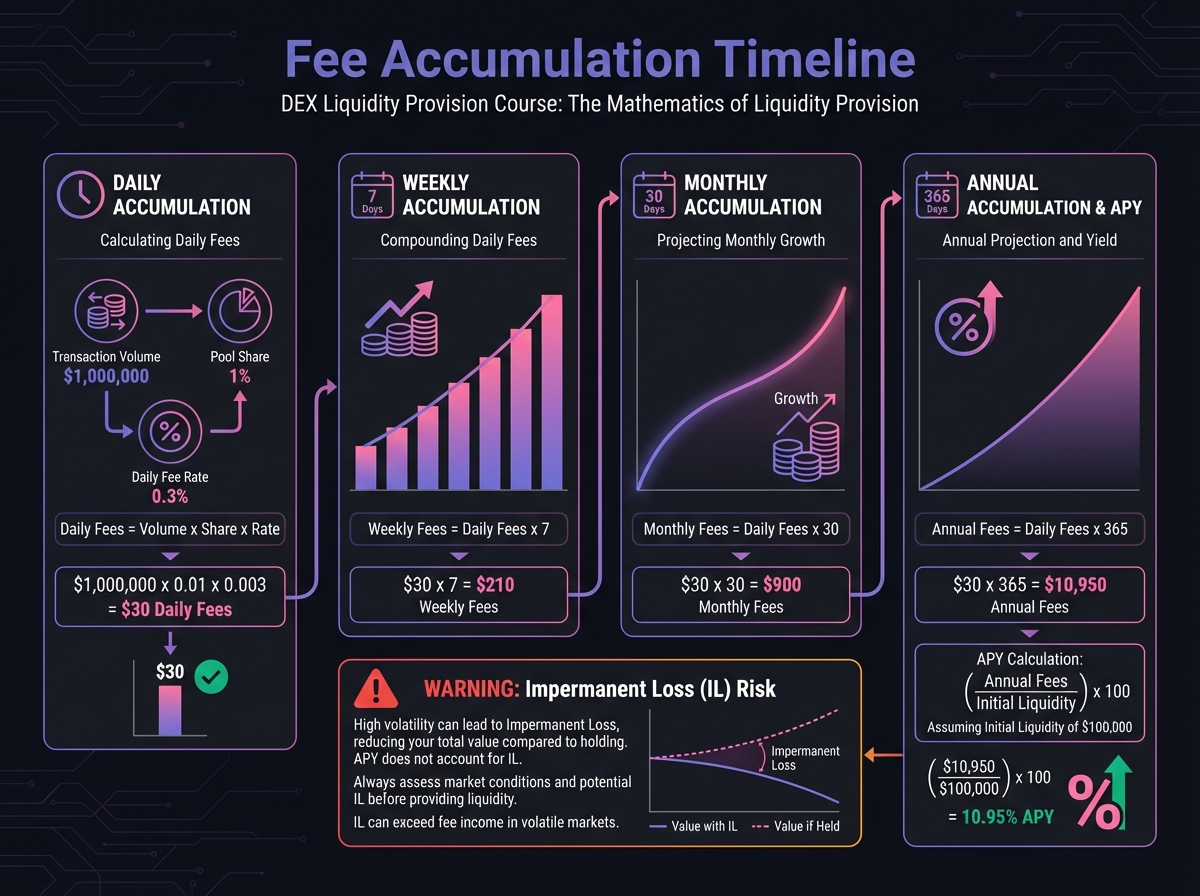
APY Calculation (Simplified)
Daily Fee Calculation: $$\text{Daily Fees} = \text{Daily Volume} \times \text{Fee Rate}$$
Your Daily Earnings: $$\text{Your Earnings} = \text{Daily Fees} \times \frac{\text{Your Capital}}{\text{Total TVL}}$$
Annualized: $$\text{APY} = \left(\frac{\text{Your Earnings}}{\text{Your Capital}} \times 365\right) \times 100%$$
Example:
- Daily volume: $1,000,000
- Fee rate: 0.3%
- Daily fees: $3,000
- Your capital: $10,000
- Total TVL: $1,000,000
- Your daily earnings: $3,000 × ($10,000 ÷ $1,000,000) = $30
- APY: ($30 ÷ $10,000) × 365 × 100% = 109.5%
⚠️ Critical Warning: This APY doesn't account for impermanent loss, which can easily exceed 100% in volatile markets!
Interactive Fee Accumulation Calculator
Use this calculator to estimate your potential fee earnings and accumulation over time based on position size, pool TVL, volume, and fee tier:

Launch Fee Accumulation Calculator →
🔬 Advanced Deep-Dive: Mathematical Properties
Invariant Preservation
The constant product formula ensures the invariant k is preserved:
Proof: After a trade of Δx for Δy: $$(x + \Delta x) \cdot (y - \Delta y) = x \cdot y + \Delta x \cdot y - \Delta y \cdot x - \Delta x \cdot \Delta y$$
For small trades, Δx · Δy ≈ 0, so: $$(x + \Delta x) \cdot (y - \Delta y) \approx x \cdot y = k$$
Price Elasticity
The price elasticity of the pool determines how sensitive prices are to trades:
$$\epsilon = \frac{%\Delta P}{%\Delta Q}$$
Where:
- ε = elasticity
- %ΔP = percentage change in price
- %ΔQ = percentage change in quantity
For constant product AMMs, elasticity is always negative (price decreases as quantity increases).
Optimal Trade Size
To minimize price impact, traders should split large orders:
Single large trade: 10 ETH
- Price impact: ~50%
- Average price: 1,500 USDC/ETH
10 smaller trades: 1 ETH each
- Price impact per trade: ~5%
- Average price: ~1,900 USDC/ETH
- Better execution by ~27%
This is why aggregators like 1inch split orders across multiple pools.
📈 Real-World Calculation: Complete Example
Let's work through a complete example:
Pool State:
- ETH reserves: 100 ETH
- USDC reserves: 200,000 USDC
- k = 100 × 200,000 = 20,000,000
- Current price: 2,000 USDC/ETH
You want to: Buy 5 ETH
Step 1: Calculate new ETH reserves
- x_new = 100 + 5 = 105 ETH
Step 2: Calculate required USDC to maintain k
- y_new = 20,000,000 ÷ 105 = 190,476.19 USDC
Step 3: Calculate USDC needed
- Δy = 200,000 - 190,476.19 = 9,523.81 USDC
Step 4: Add 0.3% fee
- Fee = 9,523.81 × 0.003 = 28.57 USDC
- Total cost = 9,523.81 + 28.57 = 9,552.38 USDC
Results:
- You pay: 9,552.38 USDC
- You receive: 5 ETH
- Effective price: 1,910.48 USDC/ETH
- Price impact: (1,910.48 - 2,000) ÷ 2,000 = -4.5%
- New pool price: 190,476.19 ÷ 105 = 1,814.06 USDC/ETH
🎓 Beginner's Corner: Common Math Mistakes
Mistake 1: Assuming linear price relationships
- Wrong: "If 1 ETH = 2,000 USDC, then 10 ETH = 20,000 USDC"
- Right: Price changes with each ETH bought. 10 ETH might cost 25,000 USDC due to slippage.
Mistake 2: Ignoring fees in calculations
- Wrong: Calculating swap amount without fees
- Right: Always include fees (typically 0.3%) in your calculations
Mistake 3: Using average price as marginal price
- Wrong: "The price is 2,000, so I'll get 1 ETH for 2,000 USDC"
- Right: You'll pay more than 2,000 due to price impact and fees
Mistake 4: Not accounting for pool depth
- Wrong: "I'll trade $100k in this $10k pool"
- Right: Check pool depth first. Your trade might move price 50%+.
🔑 Key Takeaways
- x · y = k governs all trades in constant product AMMs
- Price = y/x determines the current exchange rate
- Larger trades = more price impact due to the hyperbolic curve
- Fees compound by increasing pool reserves
- Pool depth (√k) determines how much you can trade
- APY calculations are misleading without impermanent loss
🚀 Next Steps
Now that you understand the mathematics, Lesson 3 will show you the dark side: Impermanent Loss. This is where many LPs lose money despite earning fees.
Complete Exercise 2 to practice these calculations and build your mathematical intuition.
Remember: Math protects your capital. Master these formulas, and you'll make informed decisions. Ignore them, and you'll lose money to traders who understand them better.
← Back to Summary | Next: Exercise 2 → | Previous: Lesson 1 ←