Lesson 11: Governance and Incentive Optimization
🎯 Core Concept: Liquidity as a Political Asset
In ve-token models (Aerodrome, Curve, Velodrome), liquidity provision becomes a governance game. Understanding vote-escrowed tokens, bribes, and emission optimization is essential for maximizing yields on these protocols.
🗳️ Understanding ve-Token Models
The ve(3,3) Architecture
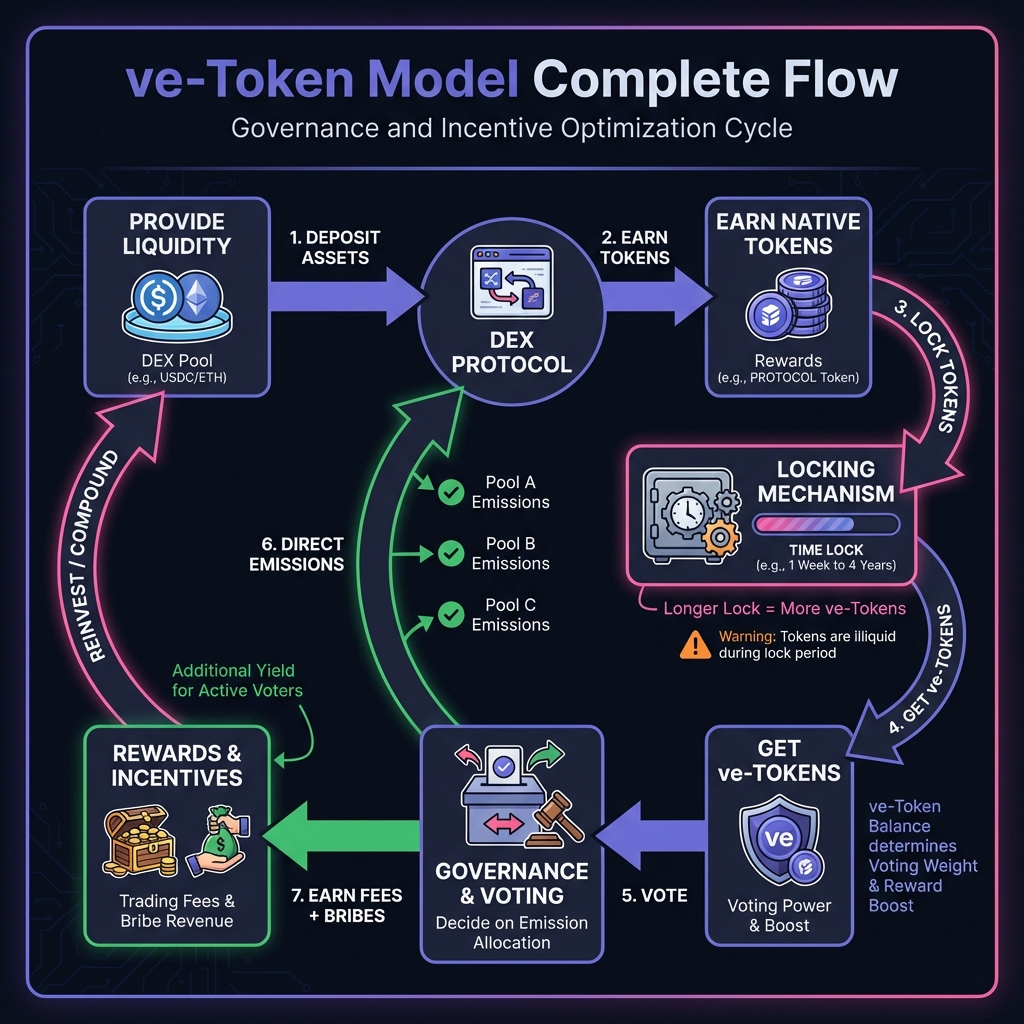
Core Concept: Lock governance tokens → Get voting power → Direct emissions → Earn fees + bribes
Key Components:
- Governance Token (e.g., AERO, CRV, VELO)
- Vote-Escrowed Token (veAERO, veCRV, veVELO)
- Gauge System (pools that receive emissions)
- Bribe Market (protocols pay voters)
How It Works
Step 1: Provide liquidity
- Deposit tokens into pool
- Receive LP tokens
Step 2: Stake LP tokens
- Stake in gauge (required!)
- Begin earning emissions
Step 3: Lock governance tokens (optional but powerful)
- Lock AERO for veAERO
- Get voting power (scales with lock duration)
Step 4: Vote and earn
- Vote for pools (direct emissions)
- Earn fees from voted pools
- Receive bribes from protocols
💰 The Bribe Market
What Are Bribes?
Bribes = Payments from protocols to ve-token holders to vote for their pools
Why Protocols Bribe:
- Direct emissions to their pool
- Attract liquidity
- Lower cost than direct incentives
Why Voters Accept Bribes:
- Additional income
- Often more than emissions value
- Passive income stream
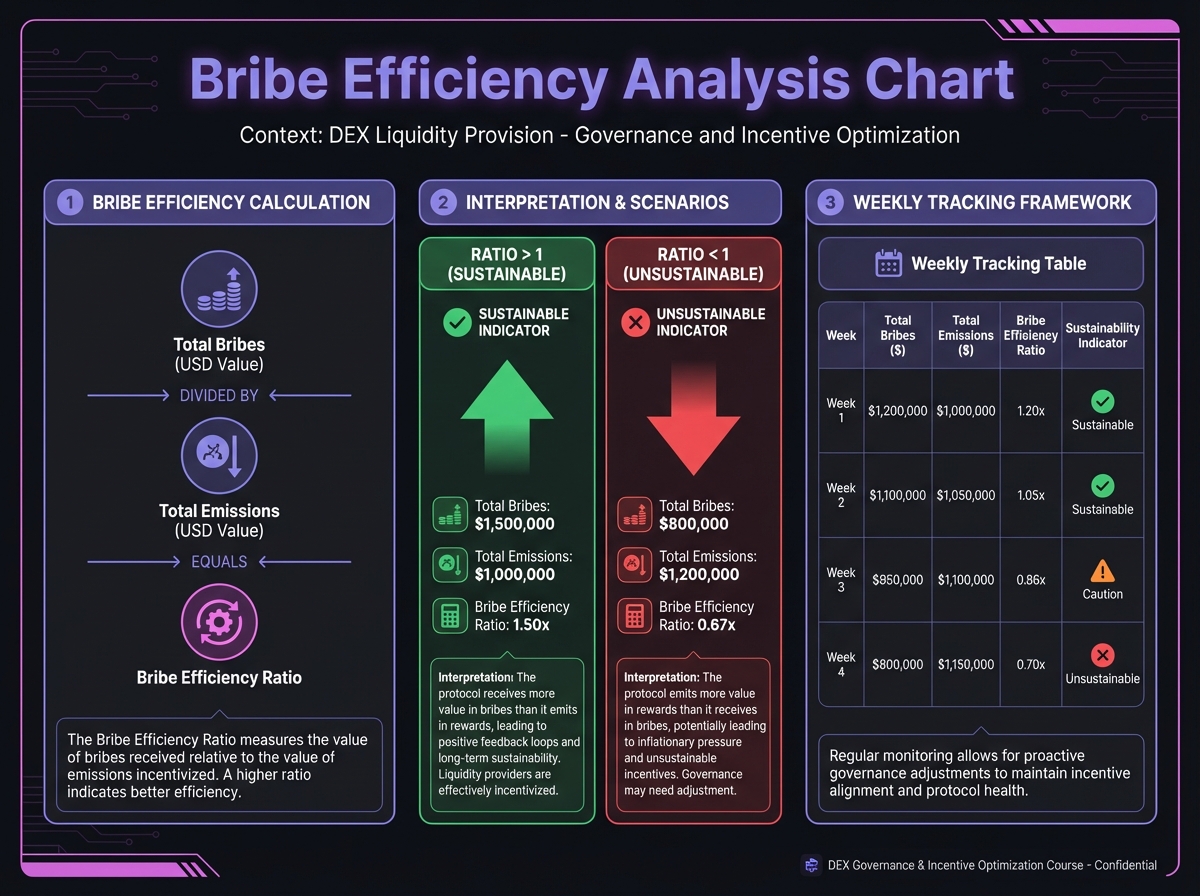
Bribe Efficiency
Formula: Bribe Efficiency = Emissions Generated ÷ Bribes Paid
Interpretation:
- Ratio > 1: Profitable for protocols (sustainable)
- Ratio < 1: Unsustainable (emissions may decline)
Best Practice: Monitor bribe efficiency weekly. High efficiency = healthy ecosystem.
Real-World Bribe Example
Scenario: Protocol wants emissions for WETH/USDC pool
Setup:
- Current emissions to pool: 1,000 AERO/week
- Protocol bribes: 500 AERO/week
- Voters receive: 500 AERO (bribe) + 1,000 AERO (emissions share)
Bribe Efficiency: 1,000 ÷ 500 = 2.0 (profitable!)
Result: Voters earn 3x more than non-voters
🎯 ve-Token Strategy Framework
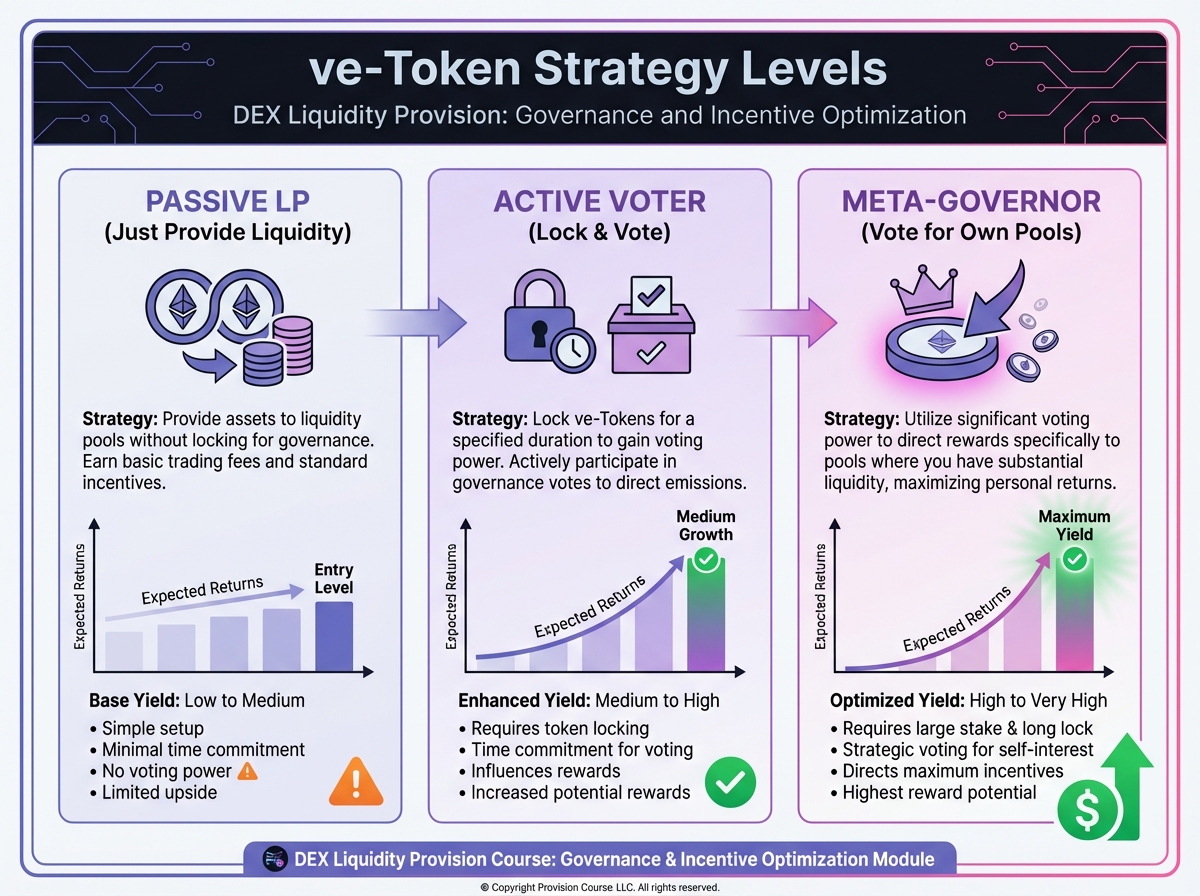
Strategy 1: Passive LP
Approach: Provide liquidity, stake, earn emissions
Steps:
- Identify high-emission pools
- Provide liquidity
- Stake LP tokens in gauge
- Earn emissions (no voting)
Best For: Beginners, small positions
Returns: Base emissions only
Strategy 2: Active Voter
Approach: Lock tokens, vote, earn bribes
Steps:
- Provide liquidity
- Earn governance tokens
- Lock tokens for ve-tokens
- Vote for high-bribe pools
- Earn emissions + fees + bribes
Best For: Medium positions, active management
Returns: Emissions + fees + bribes
Strategy 3: Meta-Governor
Approach: Vote for your own pools
Steps:
- Provide liquidity to multiple pools
- Earn governance tokens
- Lock for ve-tokens
- Vote for your own pools
- Self-reinforcing yield increase
Best For: Large positions, advanced LPs
Returns: Maximized through self-voting
📊 Emission Optimization
Identifying High-Emission Pools
Metrics to Track:
- Current vote share (%)
- Historical emissions
- Bribe amounts
- Volume/TVL ratio
Tools:
- Protocol dashboards
- Dune Analytics
- Community resources
Emission Sustainability
Red Flags:
- Declining bribe efficiency
- Decreasing total emissions
- Low protocol revenue
- High inflation rate
Green Flags:
- Increasing bribe efficiency
- Stable or growing emissions
- High protocol revenue
- Sustainable tokenomics
🔄 Cross-Protocol Incentives
Multi-Protocol Strategy
Concept: Participate in multiple ve-token protocols
Benefits:
- Diversification
- Capture best opportunities
- Reduce single-protocol risk
Example:
- Aerodrome (Base): veAERO
- Velodrome (Optimism): veVELO
- Curve (Ethereum): veCRV
Management: Requires active monitoring of multiple ecosystems
Incentive Arbitrage
Concept: Move liquidity based on emission changes
How It Works:
- Monitor emission schedules
- Identify shifts in voting
- Move liquidity to high-emission pools
- Capture yield opportunities
Risk: Gas costs, timing, competition
🔬 Advanced Deep-Dive: ve-Token Math
Voting Power Calculation
Formula: Voting Power = Locked Amount × (Lock Duration ÷ Max Duration)
Example:
- Lock 1,000 AERO for 2 years (max 4 years)
- Voting Power: 1,000 × (2 ÷ 4) = 500 veAERO
Implication: Longer locks = more voting power
Emission Distribution
Formula: Pool Emissions = Total Emissions × (Pool Votes ÷ Total Votes)
Example:
- Total emissions: 10,000 AERO/week
- Pool votes: 1,000 veAERO
- Total votes: 10,000 veAERO
- Pool emissions: 10,000 × (1,000 ÷ 10,000) = 1,000 AERO/week
Bribe ROI
Formula: Bribe ROI = (Bribes Received + Emissions Share) ÷ Locked Value
Example:
- Locked: 1,000 AERO ($1,000)
- Bribes: 50 AERO/week ($50)
- Emissions share: 100 AERO/week ($100)
- Weekly ROI: ($50 + $100) ÷ $1,000 = 15%
- Annual ROI: 780%! (if sustainable)
Reality: Emissions decline over time, ROI decreases
🎓 Beginner's Corner: Governance Basics
Q: Do I need to participate in governance? A: No, but it increases yields significantly on ve-token protocols.
Q: How much do I need to lock? A: Start small. Even 100 tokens can earn meaningful bribes if you vote strategically.
Q: What if I need to unlock early? A: Most ve-tokens can't be unlocked early. Only lock what you can commit long-term.
Q: Are bribes sustainable? A: Depends on protocol. Monitor bribe efficiency. High efficiency = more sustainable.
Q: Should I vote for my own pools? A: Yes, if you have ve-tokens. It's the most efficient strategy.
📈 Real-World ve-Token Example
Setup: Aerodrome on Base
- Capital: $20,000 in WETH/USDC pool
- Earn: 500 AERO/week from emissions
- Lock: 500 AERO for 2 years → 250 veAERO
Voting Strategy:
- Vote for WETH/USDC pool (your pool)
- Receive: 100% of pool fees + bribes
Weekly Returns:
- Emissions: 500 AERO ($500)
- Fees: 50 AERO ($50)
- Bribes: 100 AERO ($100)
- Total: 650 AERO/week ($650)
Annual: $650 × 52 = $33,800 (169% APY!)
Note: Emissions decline over time, actual returns lower
🔑 Key Takeaways
- ve-token models turn liquidity into governance participation
- Bribes can exceed emissions in value
- Voting for your pools maximizes returns
- Bribe efficiency indicates ecosystem health
- Longer locks = more voting power
- Multi-protocol participation diversifies risk
- Monitor sustainability - emissions decline over time
🚀 Next Steps
Lesson 12 is the capstone: Building Your Professional LP System. We'll integrate everything you've learned into a complete, operational system for professional liquidity provision.
Complete Exercise 11 to develop your governance participation strategy and optimize incentive capture.
Remember: Governance participation multiplies yields on ve-token protocols, but requires active management. Start small, learn the mechanics, then scale. The bribe market is powerful but can be volatile—monitor sustainability.
← Back to Summary | Next: Exercise 11 → | Previous: Lesson 10 ←