Lesson 12: Building Your Professional LP System
🎯 Core Concept: Integration and Automation
A professional LP system integrates all concepts: risk management, multi-protocol strategies, fee optimization, governance participation, and automation. This lesson shows you how to build a complete, operational system.
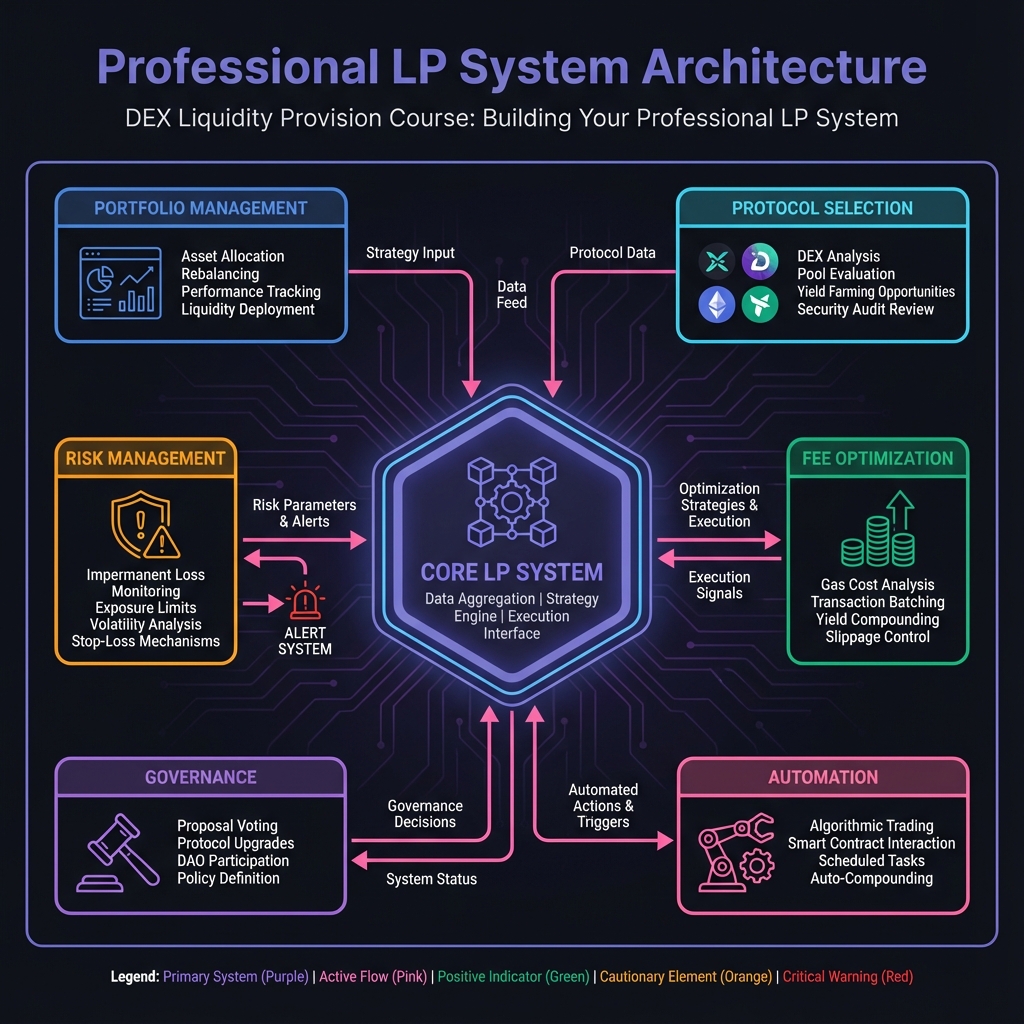
🏗️ System Architecture
Core Components
1. Portfolio Management:
- Position sizing
- Risk limits
- Diversification framework
2. Protocol Selection:
- Multi-protocol strategy
- Chain diversification
- Pair optimization
3. Risk Management:
- IL monitoring
- Hedging strategies
- Portfolio limits
4. Fee Optimization:
- Volume/TVL analysis
- Gas cost management
- Fee tier selection
5. Governance Participation:
- ve-token strategies
- Bribe optimization
- Voting systems
6. Automation:
- Monitoring tools
- Alert systems
- Rebalancing protocols
📊 The Professional LP Dashboard
Essential Metrics
Daily Tracking:
- Total portfolio value
- Fees earned (by position)
- IL by position
- Net PnL (fees - IL - gas)
- Price vs. ranges (V3)
Weekly Analysis:
- Return by protocol
- Return by pair
- Risk limit compliance
- Best/worst performers
- Rebalancing needs
Monthly Review:
- Total return vs. benchmarks
- Strategy effectiveness
- System improvements
- Capital allocation adjustments
Dashboard Tools
Manual Tracking:
- Spreadsheet (Google Sheets, Excel)
- Custom metrics
- Full control
Analytics Platforms:
- APY.vision: Real-time PnL tracking
- Revert Finance: V3 backtesting and analysis
- Zapper.fi: Multi-protocol portfolio view
- DefiLlama: TVL and volume trends
Custom Solutions:
- Dune Analytics dashboards
- Python scripts
- API integrations
🔄 Operational Workflows
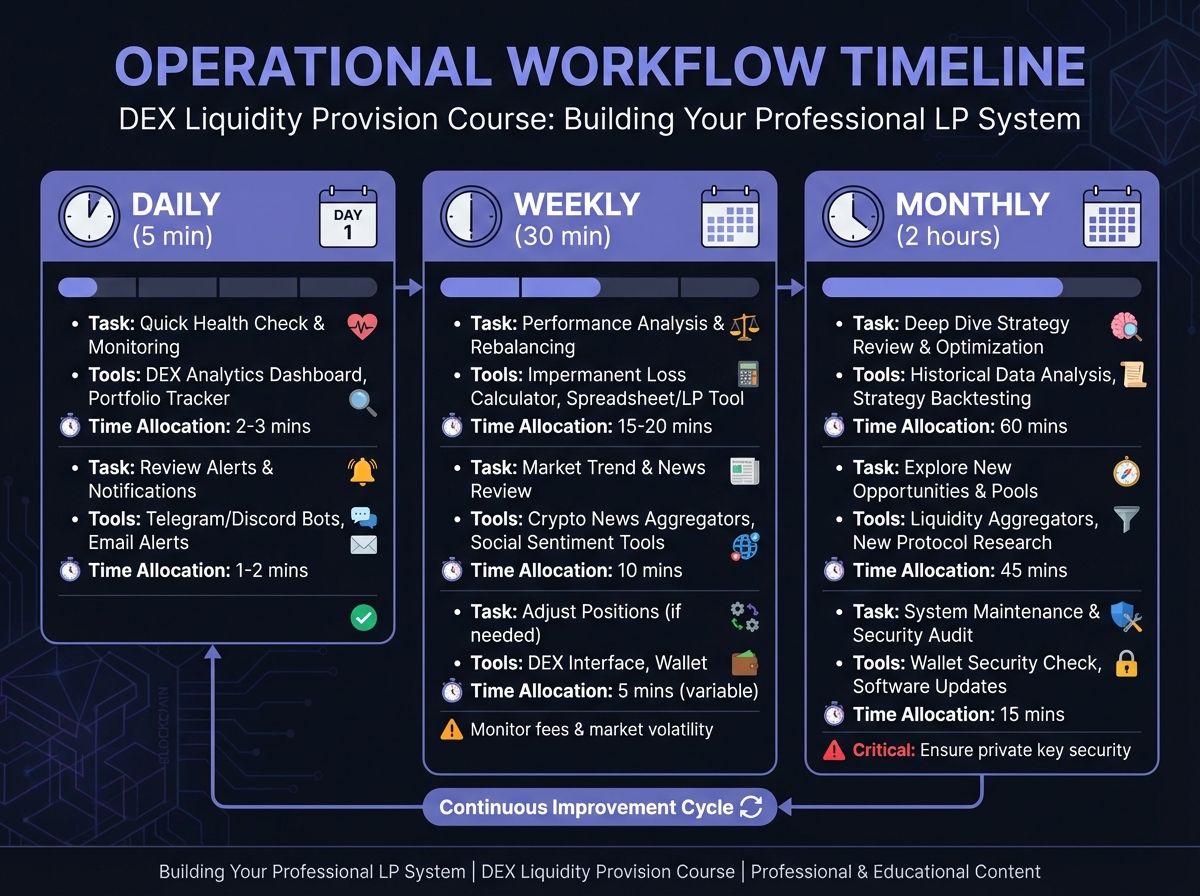
Daily Workflow (5 minutes)
-
Check Positions:
- Review all positions
- Note any out-of-range (V3)
- Check for alerts
-
Monitor Metrics:
- Fees earned
- IL changes
- Price movements
-
Review Alerts:
- IL exceeds fees?
- Price exiting range?
- Risk limits breached?
Weekly Workflow (30 minutes)
-
Performance Analysis:
- Calculate net returns
- Compare to holding
- Identify winners/losers
-
Rebalancing Decisions:
- Which positions need adjustment?
- Any new opportunities?
- Risk limit compliance?
-
Governance Updates (if applicable):
- Check bribe efficiency
- Review voting results
- Adjust voting strategy
-
System Maintenance:
- Collect fees (V3)
- Update tracking
- Review alerts
Monthly Workflow (2 hours)
-
Comprehensive Review:
- Total portfolio performance
- Strategy effectiveness
- Protocol comparison
-
Rebalancing:
- Adjust allocations
- Close underperformers
- Open new positions
-
System Optimization:
- Improve workflows
- Update tools
- Refine strategies
-
Planning:
- Set next month goals
- Adjust risk limits
- Plan capital deployment
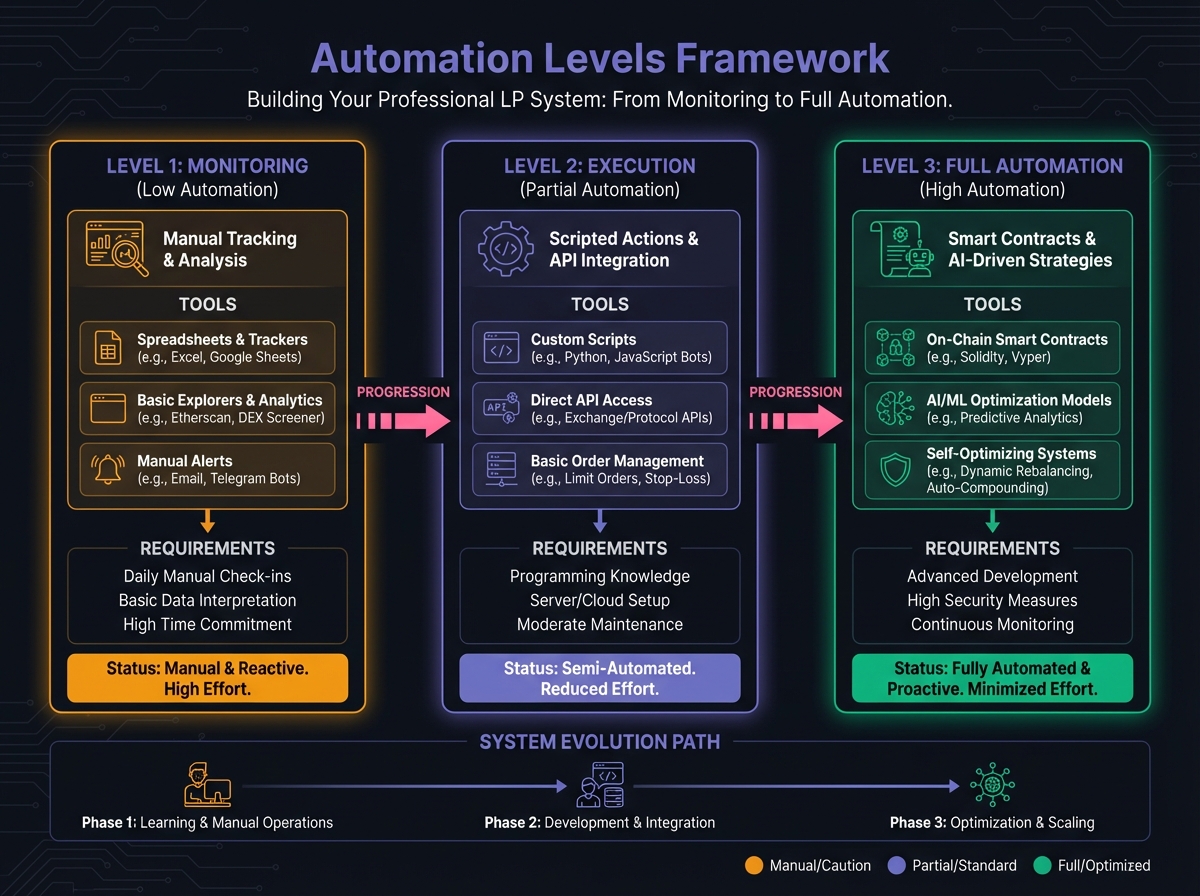
🤖 Automation Strategies
Level 1: Monitoring Automation
Tools:
- Price alerts (Telegram bots, Discord)
- IL calculators (APY.vision)
- Portfolio trackers (Zapper)
Setup:
- Alert when IL > fees
- Alert when price exits range
- Daily portfolio summary
Level 2: Execution Automation
Tools:
- Active Liquidity Managers (ALMs)
- Rebalancing bots
- Fee collection scripts
Examples:
- Arrakis Finance: Auto-rebalancing V3 positions
- Gamma Strategies: Volatility-based management
- Custom scripts: Automated fee collection
Level 3: Full Automation
Advanced:
- MEV bot integration
- Cross-protocol arbitrage
- Dynamic strategy adjustment
Requires: Technical expertise, significant capital
📋 Complete System Checklist
Setup Phase
- Define risk limits (per position, protocol, chain)
- Choose protocols (Uniswap, Aerodrome, etc.)
- Select pairs (stable, correlated, volatile)
- Set up tracking (dashboard, spreadsheet)
- Configure alerts (price, IL, risk)
- Establish workflows (daily, weekly, monthly)
Operational Phase
- Daily position checks
- Weekly performance analysis
- Monthly comprehensive review
- Continuous risk monitoring
- Regular rebalancing
- Governance participation (if applicable)
Optimization Phase
- Analyze performance data
- Identify improvement opportunities
- Test new strategies
- Refine workflows
- Upgrade tools
- Scale successful strategies
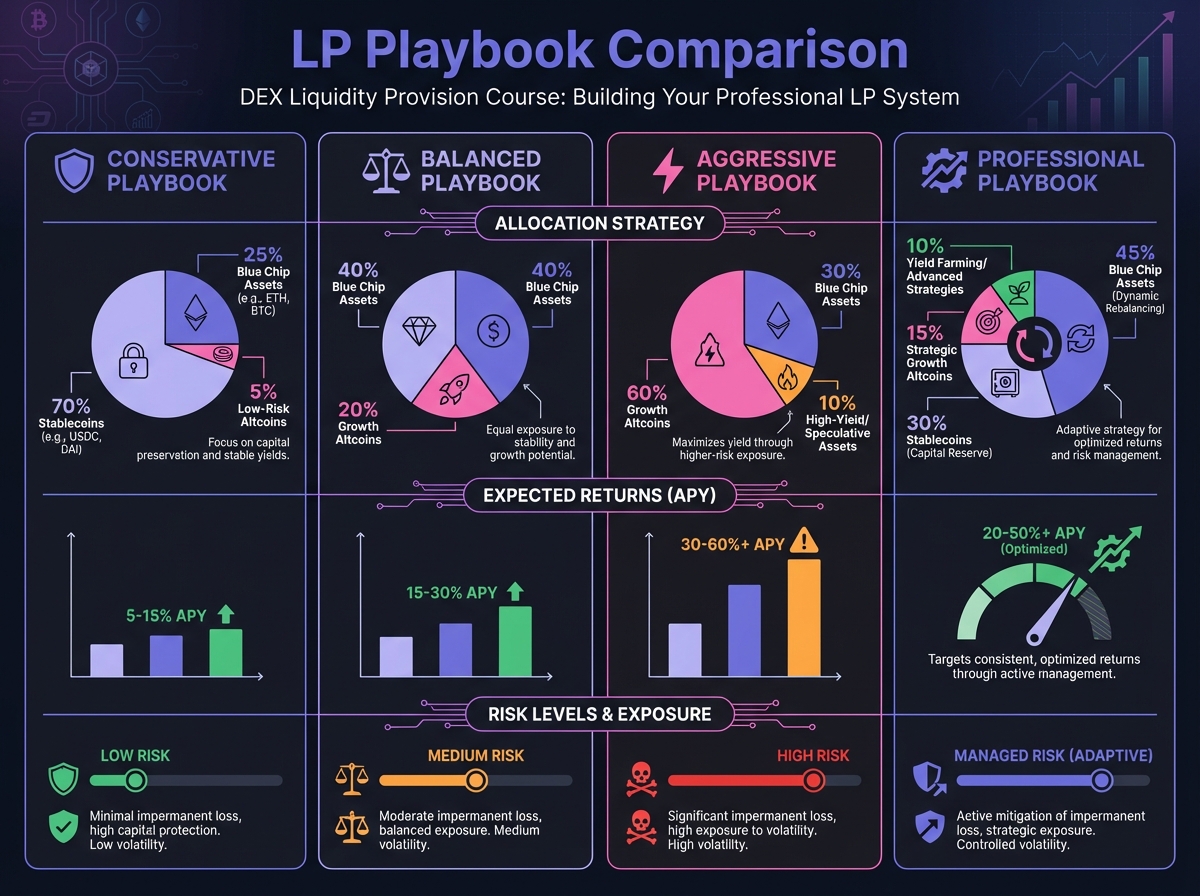
🎯 Professional LP Playbook
Playbook 1: Conservative LP
Profile: Capital preservation, steady returns
Strategy:
- 80% stablecoin pairs (USDC/USDT)
- 20% correlated pairs (wstETH/ETH)
- Uniswap V2 or wide V3 ranges
- L2 only (low gas)
- No governance participation
Expected Returns: 5-10% APY Risk Level: Low
Playbook 2: Balanced LP
Profile: Moderate risk, balanced returns
Strategy:
- 50% stablecoins
- 30% correlated pairs
- 20% blue-chip volatile (ETH/USDC)
- V3 medium ranges (±10-20%)
- Multi-protocol (Uniswap + Aerodrome)
- Basic governance participation
Expected Returns: 10-20% APY Risk Level: Moderate
Playbook 3: Aggressive LP
Profile: High risk, maximum returns
Strategy:
- 30% stablecoins
- 40% volatile pairs
- 30% governance tokens (ve-token protocols)
- V3 narrow ranges (±1-5%)
- Multi-chain, multi-protocol
- Active governance participation
- Hedging strategies
Expected Returns: 20-50% APY (variable) Risk Level: High
Playbook 4: Professional LP
Profile: Institutional-grade, systematic
Strategy:
- Diversified across all categories
- Delta hedging
- ALM protocols
- Custom automation
- Full governance participation
- MEV protection
- Risk management systems
Expected Returns: 15-30% APY (consistent) Risk Level: Managed
🔬 Advanced Deep-Dive: System Integration
API Integration
Connect:
- DEX APIs (Uniswap, Aerodrome)
- Price oracles (Chainlink, Uniswap TWAP)
- Analytics platforms (APY.vision, Revert)
Build:
- Custom dashboards
- Automated monitoring
- Alert systems
- Performance tracking
Smart Contract Integration
Deploy:
- Custom rebalancing contracts
- Fee collection automation
- Multi-protocol managers
Requires: Solidity development, security audits
Data Pipeline
Collect:
- Position data
- Price feeds
- Volume metrics
- Fee data
Process:
- Calculate metrics
- Generate alerts
- Produce reports
Store:
- Historical data
- Performance tracking
- Strategy backtesting
📈 Real-World Professional System
Complete Example
Portfolio: $100,000 across 3 chains
Allocation:
- $40,000 Uniswap V3 (Arbitrum): ETH/USDC, WBTC/ETH
- $30,000 Aerodrome (Base): WETH/USDC, veAERO participation
- $30,000 Raydium (Solana): SOL/USDC, RAY/USDC
Management:
- Daily: Automated alerts, position checks
- Weekly: Performance analysis, rebalancing decisions
- Monthly: Comprehensive review, strategy optimization
Tools:
- APY.vision: PnL tracking
- Revert Finance: V3 analysis
- Custom spreadsheet: Portfolio management
- Telegram bots: Price alerts
Returns (monthly):
- Uniswap: $400 fees, $100 IL = $300 net
- Aerodrome: $600 emissions+fees, $50 IL = $550 net
- Raydium: $300 fees, $80 IL = $220 net
- Total: $1,070/month (1.07% = 12.8% APY)
Risk Management:
- Per-position limit: 10%
- Per-protocol limit: 40%
- Per-chain limit: 50%
- All within limits ✅
🎓 Beginner's Corner: Building Your System
Q: Do I need all this complexity? A: No. Start simple: one protocol, one pair, basic tracking. Add complexity as you learn.
Q: What's the minimum viable system? A: One position, weekly check, basic spreadsheet. That's enough to start.
Q: Should I automate everything? A: Not initially. Learn manually first, then automate repetitive tasks.
Q: How much time does this take? A: 5 min/day, 30 min/week, 2 hours/month. Scale with portfolio size.
Q: What if I can't build custom tools? A: Use existing platforms (APY.vision, Revert). They're sufficient for most LPs.
🔑 Key Takeaways
- Professional systems integrate all concepts into workflows
- Daily/weekly/monthly routines ensure consistent management
- Automation scales with portfolio size and complexity
- Multiple playbooks suit different risk profiles
- Tools and dashboards are essential for professional LPing
- Start simple, add complexity gradually
- Systematic approach beats ad-hoc management
🚀 Course Completion
Congratulations! You've completed the DEX Liquidity Provision Mastery course. You now understand:
- ✅ AMM fundamentals and mathematics
- ✅ Impermanent loss and risk management
- ✅ Uniswap V2, V3, and V4
- ✅ Multi-protocol strategies
- ✅ Fee optimization and gas economics
- ✅ Advanced tactics (MEV, governance, hooks)
- ✅ Building professional LP systems
Next Steps:
- Complete Exercise 12 to build your personal LP system
- Start with small positions
- Track everything
- Learn from experience
- Scale gradually
- Never stop learning
Remember: Liquidity provision is a skill that improves with practice. Start conservative, learn systematically, and build your expertise over time. The markets reward disciplined, educated LPs.
Final Thought: Professional liquidity provision combines mathematics, risk management, and systematic execution. Master these fundamentals, and you'll build sustainable returns in DeFi's most important role.
← Back to Summary | Next: Exercise 12 → | Previous: Lesson 11 ←