Lesson 8: Risk Management and Hedging Strategies
🎯 Core Concept: Protect Capital First
Professional LPs don't just earn fees—they manage risk. This lesson teaches advanced risk management techniques including delta hedging, LVR mitigation, and portfolio-level risk controls.
🛡️ The Risk Management Framework
Three Types of Risk
1. Impermanent Loss (IL):
- Opportunity cost vs. holding
- Reversible if price returns
- Mitigated by: Stable pairs, hedging
2. Loss Versus Rebalancing (LVR):
- Value extracted by arbitrageurs
- Never reversible (monotonic)
- Mitigated by: Lower volatility pairs, faster chains
3. Smart Contract Risk:
- Bugs, exploits, hacks
- Permanent loss
- Mitigated by: Audited protocols, diversification

📊 Delta Hedging Strategy
The Concept
Delta = Sensitivity of position to price changes
Delta Hedging = Neutralize price exposure, profit only from fees
How It Works
Step 1: Provide liquidity (long both assets)
- Example: 1 ETH + 2,000 USDC in pool
- Delta: Long ETH exposure
Step 2: Short ETH to hedge
- Borrow ETH on Aave
- Sell ETH for USDC
- Delta: Short ETH exposure
Step 3: Net position
- Long ETH (from LP) + Short ETH (from borrow) = Delta neutral
- Profit: Fees - Borrowing costs
Complete Example
Setup:
- LP Position: $10,000 (5 ETH + 10,000 USDC at $2,000/ETH)
- Borrow: 5 ETH on Aave (50% LTV)
- Sell: 5 ETH for 10,000 USDC
- Net: Delta neutral
Monthly:
- LP Fees: $100
- Borrowing cost: $50 (5% APY on ETH)
- Net: $50/month (0.5% monthly = 6% APY)
If ETH drops 20%:
- LP IL: -$1,000
- Short profit: +$1,000
- Net: $0 (hedged!)
If ETH rises 20%:
- LP IL: -$1,000
- Short loss: -$1,000
- Net: $0 (hedged!)
Result: Isolated fee yield, no price exposure!
When to Hedge
Hedge if:
- ✅ Large positions ($50k+)
- ✅ Volatile pairs
- ✅ Want pure fee yield
- ✅ Can afford borrowing costs
Don't hedge if:
- ❌ Small positions (costs too high)
- ❌ Stable pairs (IL minimal)
- ❌ Want price exposure
- ❌ Can't afford borrowing

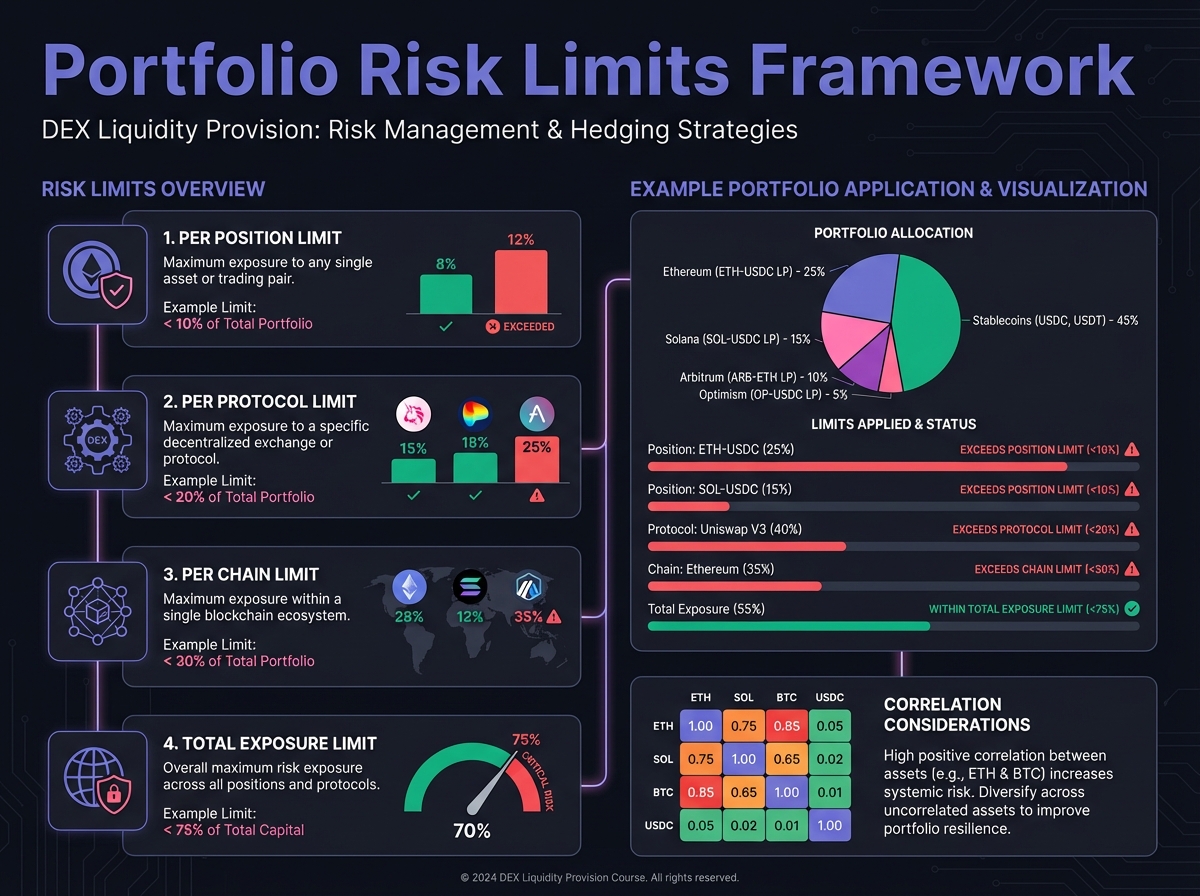
🔄 Portfolio Risk Management
Position Sizing
Rule 1: Never risk more than 5-10% per position Rule 2: Diversify across pairs, protocols, chains Rule 3: Correlated pairs count as one position
Correlation Matrix
High Correlation (count as 1 position):
- ETH/BTC
- wstETH/ETH
- USDC/USDT
Low Correlation (separate positions):
- ETH/meme coin
- Stablecoin/volatile asset
Risk Limits
Maximum Exposure:
- Single pair: 10% of portfolio
- Single protocol: 25% of portfolio
- Single chain: 50% of portfolio
Example ($100k portfolio):
- Uniswap V3 ETH/USDC: $10k (10%)
- Aerodrome WETH/USDC: $10k (10%)
- Raydium SOL/USDC: $10k (10%)
- Reserve: $70k (70%)
🎯 LVR Mitigation Strategies
Strategy 1: Lower Volatility Pairs
LVR Formula: LVR ∝ σ² (volatility squared)
Implication: Halving volatility = 4x less LVR
Action: Choose stable or correlated pairs
Strategy 2: Faster Chains
LVR is block-time sensitive:
- Ethereum (12s blocks): Higher LVR
- Arbitrum (0.25s blocks): Lower LVR
- Solana (0.4s blocks): Lower LVR
Action: Use L2s or alternative chains
Strategy 3: Dynamic Fees
Meteora adjusts fees with volatility:
- Higher volatility = Higher fees
- Compensates for increased LVR
Action: Consider Meteora for volatile pairs
🔬 Advanced Deep-Dive: Options-Based Hedging
Protective Puts
Strategy: Buy put options to protect downside
Example:
- LP Position: $10,000 ETH/USDC
- Buy: $10,000 put option (strike $1,800)
- Cost: $200 (2%)
If ETH drops to $1,600:
- LP Loss: -$1,000
- Put Profit: +$1,000
- Net: -$200 (just option cost)
If ETH stays above $1,800:
- LP: Normal returns
- Put: Expires worthless
- Net: -$200 (option cost)
Covered Calls
Strategy: Sell call options to generate income
Example:
- LP Position: $10,000 ETH/USDC
- Sell: $10,000 call option (strike $2,200)
- Premium: $150 (1.5%)
If ETH stays below $2,200:
- LP: Normal returns
- Call: Expires worthless
- Net: +$150 (premium earned)
If ETH rises above $2,200:
- LP: Normal returns (capped)
- Call: Exercised (sell ETH at $2,200)
- Net: Premium + capped gains

📈 Risk Monitoring Dashboard
Key Metrics to Track
Daily:
- Current IL vs. fees earned
- Position value changes
- Price vs. range boundaries
Weekly:
- Net PnL (fees - IL - gas)
- Comparison to holding
- Risk limit compliance
Monthly:
- Total return analysis
- Portfolio rebalancing
- Strategy adjustments
Risk Alerts
Set Alerts For:
- IL exceeds fees (losing money)
- Price exits range (V3)
- Position exceeds risk limits
- Gas costs exceed fees
🎓 Beginner's Corner: Risk Management Basics
Q: Do I need to hedge? A: Only for large positions ($50k+) or very volatile pairs. Start without hedging, learn first.
Q: How much should I risk? A: Start with 1-5% of portfolio per position. Increase as you learn.
Q: What if IL exceeds fees? A: Withdraw and reassess. Don't wait hoping it improves.
Q: Should I diversify? A: Yes! Across pairs, protocols, and chains. Don't put all eggs in one basket.
Q: How do I monitor risk? A: Use analytics tools (APY.vision, Revert Finance) or track manually weekly.
Interactive Rebalancing Strategy Planner
Use this tool to plan your rebalancing strategies and optimize risk management across your LP positions:

Launch Rebalancing Strategy Planner →
🔑 Key Takeaways
- Risk management protects capital - fees alone aren't enough
- Delta hedging isolates fee yield from price exposure
- Portfolio limits prevent catastrophic losses
- LVR mitigation requires low volatility or fast chains
- Options hedging is advanced but powerful
- Monitor risk metrics weekly to catch problems early
- Start conservative - increase risk as you learn
🚀 Next Steps
Module 3 covers elite operations: Uniswap V4, MEV tactics, governance, and building complete LP systems. These advanced topics require solid risk management foundations.
Complete Exercise 8 to develop your risk management framework and calculate hedging strategies.
Remember: Professional LPs manage risk first, optimize returns second. Protect your capital, and the fees will follow. Unmanaged risk destroys more LP positions than low fees.
← Back to Summary | Next: Exercise 8 → | Previous: Lesson 7 ←