Lesson 3: Architecture Types and Market Structure
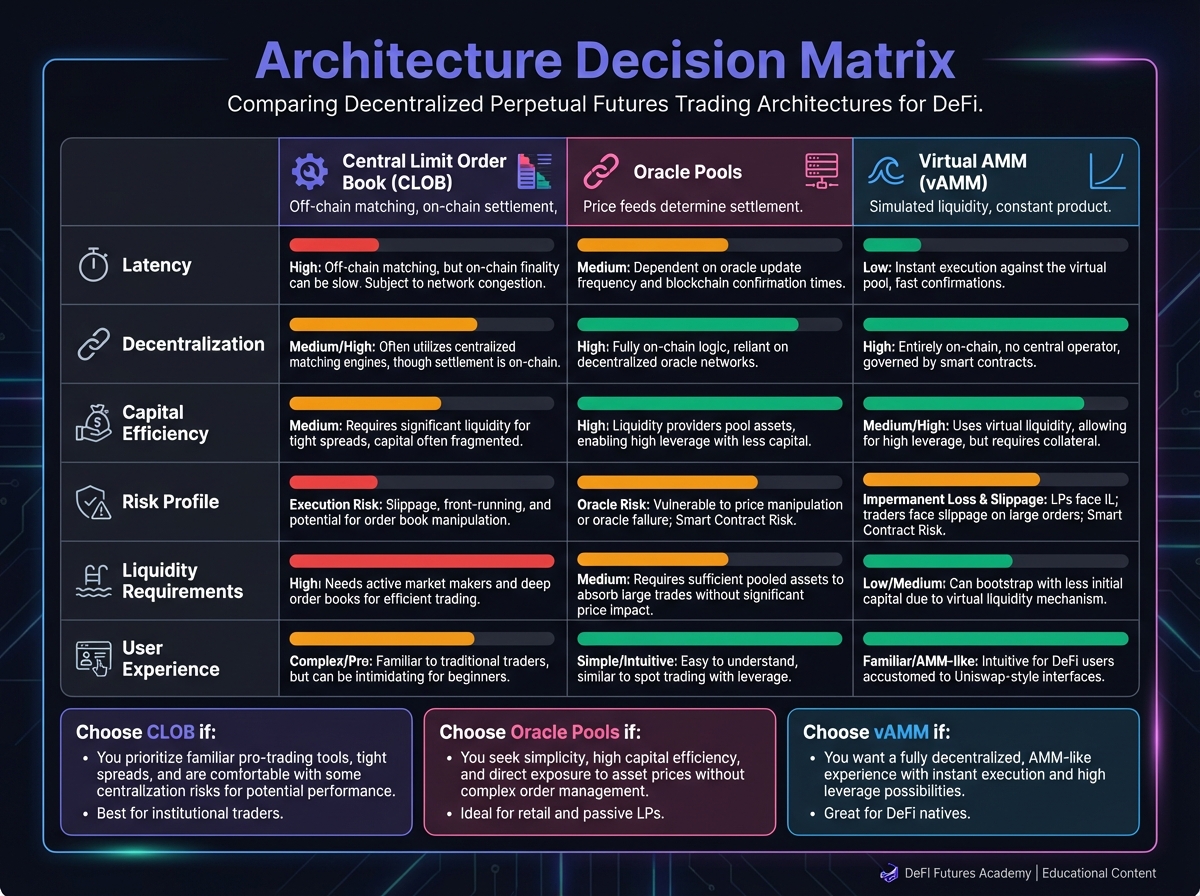
🎯 Core Concept: Architecture Determines Everything
Understanding the architecture of a perpetual DEX is the single most critical factor in assessing risk and choosing the right platform for your strategy. The architecture dictates:
- How prices are discovered
- Where liquidity comes from
- What risks you face
- What fees you pay
- How fast trades execute
This lesson is foundational—master it before moving to protocol-specific lessons.
🏗️ The Three Architectural Models
The perpetual DEX market has evolved into three primary architectural categories:
- Central Limit Order Book (CLOB)
- Oracle-Based Shared Liquidity Pools
- Virtual AMM (vAMM)
Each model presents unique trade-offs regarding latency, decentralization, capital efficiency, and risk.
📚 Model 1: Central Limit Order Book (CLOB)
How CLOB Works
The CLOB model replicates the traditional exchange experience:
- Market Makers post buy/sell orders at specific prices
- Traders execute against the order book
- Price Discovery happens through supply and demand
- Matching occurs when buy and sell orders cross
Think of it like: A traditional stock exchange (NASDAQ, NYSE) but on-chain.
CLOB Sub-Models
Application-Specific Blockchains (AppChains)
Examples: dYdX v4, Hyperliquid
How It Works:
- Exchange runs on its own dedicated blockchain
- Optimized exclusively for trading activity
- High throughput and low latency
dYdX v4 (Cosmos SDK):
- In-memory order book maintained by validators off-chain
- Trades committed on-chain for settlement
- ~2,000 TPS capacity
- Decentralized matching engine (validators)
Hyperliquid (HyperEVM):
- Entire order book fully on-chain
- Custom consensus (HyperBFT) for low latency
- ~200,000 orders/second capacity
- Sub-second latency (0.2s)
Benefits:
- ✅ CEX-like performance
- ✅ Transparent order book
- ✅ Limit orders, stop losses
- ✅ Deep liquidity (if market makers active)
Risks:
- ❌ Slippage on large orders
- ❌ Front-running risk
- ❌ Requires active market makers
- ❌ Bridge risk (moving assets to AppChain)
Hybrid Off-Chain Matching
Examples: Vertex (Arbitrum), ApeX (StarkEx), EdgeX (Starknet)
How It Works:
- Off-chain sequencer matches orders (lightning fast)
- Trades settled on-chain (L2 rollup)
- Best of both worlds: CeFi speed + DeFi security
Benefits:
- ✅ Very low latency (<10ms matching)
- ✅ On-chain settlement (self-custody)
- ✅ No MEV (sequencer handles matching)
- ✅ Works on existing L2s
Risks:
- ❌ Sequencer centralization
- ❌ Trust in sequencer not to front-run
- ❌ Still requires bridging to L2
CLOB Characteristics
| Feature | Description |
|---|---|
| Price Discovery | Internal (supply/demand in order book) |
| Slippage | Yes (depends on order book depth) |
| Liquidity Source | Market makers providing quotes |
| Latency Risk | Front-running order placement |
| Trader Experience | CEX-like, limit orders, advanced order types |
| Capital Efficiency | High (market makers provide liquidity) |

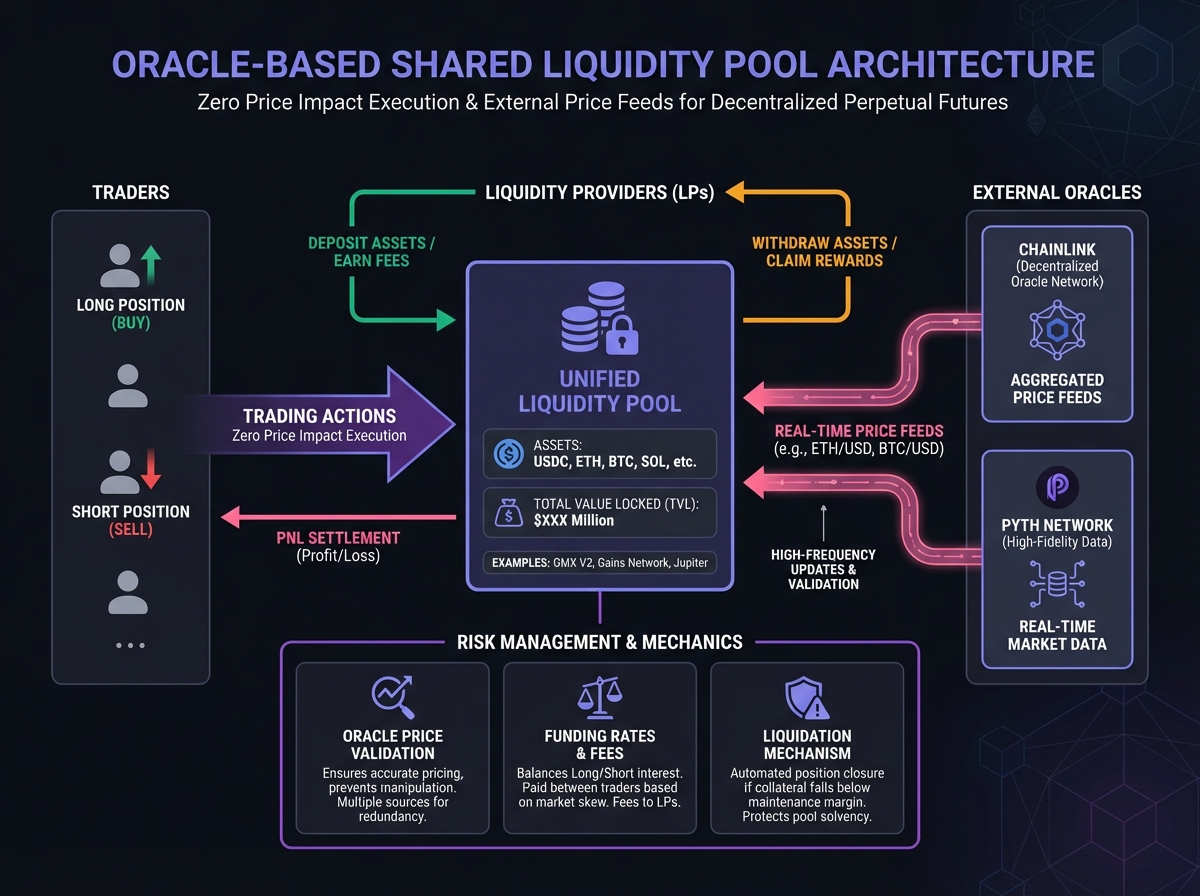
💧 Model 2: Oracle-Based Shared Liquidity Pools
How Oracle Pools Work
This model eliminates the order book entirely:
- Liquidity Providers (LPs) deposit assets into a unified pool
- Traders trade against the pool (not other traders)
- Prices come from external oracles (Chainlink, Pyth)
- Zero Price Impact (executed at oracle price)
Think of it like: Trading against a casino—the house (pool) is always the counterparty.
Oracle Pool Mechanism
Examples: GMX V2, Gains Network, Jupiter
How It Works:
- LPs deposit assets (ETH, BTC, USDC) into pool
- Pool acts as counterparty to all trades
- Oracle provides price (from Binance, Coinbase, etc.)
- Trades execute at oracle price (zero slippage)
- If trader wins → pool pays; if trader loses → pool collects
Key Innovation: No need for market makers or order books. The pool provides infinite liquidity (up to pool size) at the oracle price.
Oracle Pool Characteristics
| Feature | Description |
|---|---|
| Price Discovery | External (oracle feed from CEXs) |
| Slippage | No (zero price impact at oracle price) |
| Liquidity Source | LPs depositing into pool |
| Latency Risk | Oracle latency arbitrage |
| Trader Experience | Swap-like, simple execution |
| Capital Efficiency | Very high for LPs (one pool for all trades) |
Benefits of Oracle Pools
- ✅ Zero Slippage: Execute any size at oracle price
- ✅ Simple UX: No need to understand order books
- ✅ Deep Liquidity: Pool aggregates all LP capital
- ✅ No Market Makers Needed: Pool provides liquidity
Risks of Oracle Pools
- ❌ Oracle Latency: Price updates lag real market
- ❌ Toxic Flow: Arbitrageurs exploit stale prices
- ❌ Pool Insolvency: If traders win big, pool can drain
- ❌ No Price Discovery: Prices come from external sources
🔄 Model 3: Virtual AMM (vAMM)
How vAMM Works
The vAMM model adapts the constant product formula for synthetic leverage:
- No Real Assets: Virtual tokens in the curve
- Price Discovery: Algorithmic (based on virtual reserves)
- Real Collateral: Stored in smart contract vault
- Arbitrage Required: To keep price aligned with spot
Examples: Perpetual Protocol (original), modern iterations with oracle safeguards
How It Works:
- Virtual pool uses formula: $x \cdot y = k$
- No real assets swapped—just virtual reserves
- Real collateral stored in vault
- Price calculated from virtual token ratio
- Arbitrageurs keep vAMM price aligned with spot
vAMM Characteristics
| Feature | Description |
|---|---|
| Price Discovery | Internal (algorithmic curve) |
| Slippage | Yes (depends on k-value) |
| Liquidity Source | LPs providing virtual tokens |
| Latency Risk | Front-running transactions |
| Trader Experience | Swap-like |
| Capital Efficiency | Moderate (requires arbitrage) |
Benefits of vAMM
- ✅ Fully On-Chain: No external oracles (initially)
- ✅ Decentralized: Price discovery on-chain
- ✅ Simple Model: Easy to understand
Risks of vAMM
- ❌ High Slippage: Large trades move price significantly
- ❌ Arbitrage Dependency: Needs active arbitrageurs
- ❌ Price Divergence: Can drift from spot if arbitrage insufficient
- ❌ Modern Iterations: Often add oracle safeguards (hybrid model)

📊 Comparative Analysis Table
| Feature | CLOB | Oracle Pools | vAMM |
|---|---|---|---|
| Examples | dYdX, Hyperliquid, Vertex | GMX, Gains, Jupiter | Perpetual Protocol |
| Price Discovery | Internal (Supply/Demand) | External (Oracle Feed) | Internal (Algorithmic) |
| Slippage | Yes (depends on depth) | No (Zero slippage) | Yes (depends on k-value) |
| Liquidity Source | Market Makers | LPs (Public Pool) | LPs (Virtual Tokens) |
| Latency Risk | Front-running orders | Oracle latency arbitrage | Front-running transactions |
| Trader Experience | CEX-like, limit orders | Swap-like, simple | Swap-like |
| Capital Efficiency | High (market makers) | Very High (pooled) | Moderate (arbitrage needed) |
| Complexity | Medium (understand order book) | Low (simple execution) | Medium (understand curve) |
🎓 Beginner's Corner: Which Architecture Should You Choose?
Choose CLOB If:
- You want CEX-like experience (limit orders, stop losses)
- You're comfortable with order books
- You need precise entry/exit prices
- You're an active trader (scalping, day trading)
Best For: Professional traders, market makers, active day traders
Choose Oracle Pools If:
- You want simple execution (swap-like)
- You need zero slippage on large orders
- You don't want to worry about order book depth
- You prefer passive liquidity provision
Best For: Casual traders, large position traders, LP providers
Choose vAMM If:
- You want fully on-chain price discovery
- You're comfortable with AMM mechanics
- You understand arbitrage dynamics
- You prefer decentralized models
Best For: DeFi natives, arbitrageurs, protocol enthusiasts
🔬 Advanced Deep-Dive: Hybrid Architectures
Many modern protocols combine elements of multiple models:
Drift Protocol: The Liquidity Trifecta
Drift uses a three-layer system:
- JIT Auction: Market makers compete to fill orders
- DLOB: Decentralized limit order book
- DAMM: Dynamic AMM as backstop
This hybrid approach:
- Protects LPs from toxic flow (JIT makers step in first)
- Provides order book precision (DLOB)
- Ensures liquidity always exists (DAMM backstop)
GMX V2: Isolated Pools
GMX V2 moved from unified pool (GLP) to isolated pools:
- Each market has its own pool (ETH pool, BTC pool, etc.)
- Risk isolation (one market failure doesn't affect others)
- Still oracle-based (zero slippage)
- More capital efficient for LPs (choose exposure)
Extended: Unified Margin + CLOB
Extended combines:
- CLOB for order book trading
- Unified Margin across all positions
- Yield-Bearing Collateral (stETH, sDAI)
- Account Abstraction for EVM compatibility
This creates a "super-app" experience with advanced features.
⚠️ Critical Risk Differences by Architecture
CLOB Risks
- Slippage Risk: Large orders move price
- Front-Running: MEV bots can front-run your orders
- Liquidity Risk: Thin order books = high slippage
- Market Maker Dependency: Need active makers for liquidity
Oracle Pool Risks
- Oracle Latency: Stale prices = arbitrage opportunities
- Toxic Flow: Informed traders exploit pool
- Pool Insolvency: If traders win big, pool can drain
- Oracle Manipulation: Rare but possible
vAMM Risks
- High Slippage: Large trades move price significantly
- Arbitrage Dependency: Needs active arbitrageurs
- Price Divergence: Can drift from spot
- Capital Inefficiency: Requires large k-value for depth
📈 Real-World Examples
Example 1: Large Order on CLOB
Scenario: Want to buy $100,000 worth of ETH perp on Hyperliquid
- Order Book Depth: $50,000 at best bid
- Result: Your order will move price (slippage)
- Solution: Split into smaller orders or use limit orders over time
Example 2: Large Order on Oracle Pool
Scenario: Want to buy $100,000 worth of ETH perp on GMX
- Oracle Price: $2,500
- Pool Depth: $50M
- Result: Execute at $2,500 (zero slippage)
- Solution: No solution needed—just execute
Example 3: Funding Rate Arbitrage
Scenario: ETH perp funding rate is 0.1% per hour (very high)
- CLOB: Can't easily arbitrage (slippage costs)
- Oracle Pool: Can arbitrage (zero slippage)
- Result: Oracle pools better for arbitrage strategies
🔑 Key Takeaways
- Architecture determines risk profile: CLOB = slippage risk, Oracle = oracle risk
- CLOB offers CEX-like experience: Limit orders, stop losses, order book depth
- Oracle pools offer zero slippage: But face oracle latency and toxic flow risks
- vAMM offers on-chain price discovery: But requires arbitrage and has slippage
- Hybrid models combine benefits: Modern protocols use multiple layers
- Choose based on strategy: Active trading = CLOB, Large orders = Oracle pools
🚀 Next Steps
- Proceed to Lesson 4 to learn how to open your first position
- Explore different protocols to see architectures in action
- Consider which architecture fits your trading style
- Complete Exercise 3 to practice architecture analysis
Next Lesson: In Lesson 4, we'll explore opening your first perpetual position.