Lesson 11: Advanced Topics and Emerging Trends
🎯 Core Concept: The Future of Perpetual Trading
The perpetual DEX landscape is rapidly evolving. This lesson explores cutting-edge innovations, emerging trends, and advanced features that are shaping the future of on-chain derivatives trading. Understanding these trends helps you stay ahead and adapt your strategies.
Why Emerging Trends Matter
The DeFi perpetual space moves fast:

- New protocols launch monthly
- Features evolve rapidly
- UX improvements change how we trade
- Capital efficiency innovations unlock new strategies
Stay Ahead: Understanding trends helps you:
- Adopt new features early
- Optimize your strategies
- Avoid outdated approaches
- Capitalize on new opportunities
📱 Mobile-First Trading Revolution
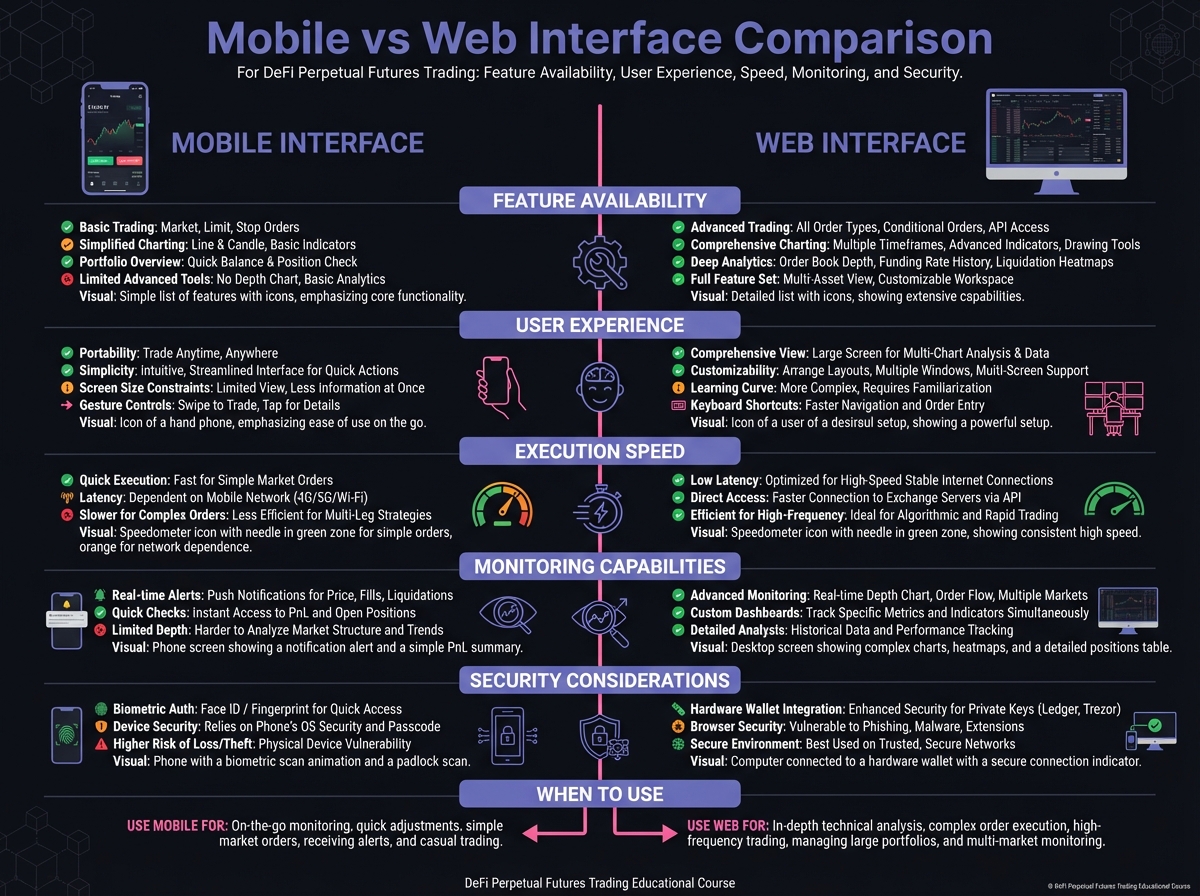
The Mobile Trading Shift
The Trend: Retail trading is increasingly mobile-first, especially in Asia.
Statistics:
- 70%+ of retail volume on mobile
- Mobile-native protocols gaining market share
- Native apps outperforming web interfaces
Native Apps vs. Mobile Web
Native App Advantages (EdgeX example):
- Persistent Connections: WebSocket stays active in background
- Hardware Acceleration: GPU-accelerated charting
- Biometric Security: FaceID/TouchID for signing
- Push Notifications: Sub-100ms alerts
- Drag-to-Set Orders: TP/SL directly on charts
Mobile Web Limitations:
- Browser throttling (connections suspended)
- Reconnection lag (stale state)
- Higher touch latency
- Limited notification reliability
Impact on Trading
For Scalpers:
- Native apps = faster execution
- Critical for high-frequency strategies
- Mobile web = missed opportunities
For Swing Traders:
- Push notifications = better monitoring
- Native apps = more reliable alerts
- Mobile web = missed liquidations
Future: Expect more protocols to launch native apps.
🔐 Account Abstraction and UX Innovation
The Account Abstraction Revolution
What It Is: Smart contract wallets that abstract away blockchain complexity.
Extended's Implementation:
- EVM users sign with MetaMask
- Extended deploys Starknet smart contract wallet
- Contract accepts Ethereum signatures
- No explicit bridging needed
Benefits:
- No Bridge Friction: Trade on Starknet using MetaMask
- Gas Abstraction: Pay fees in USDC, not native token
- Social Recovery: Recover wallets via social methods
- Batch Transactions: Multiple actions in one transaction
Unified Margin Systems
The Innovation: Single margin pool across all products.
Extended's Approach:
- Spot, perps, lending in one account
- Unified margin calculation
- Cross-product hedging
- Capital efficiency
Drift's Approach:
- Spot, perps, lending, prediction markets
- All share same collateral
- Portfolio-level risk management
Future: More protocols will adopt unified margin.
💎 Yield-Bearing Collateral
The Capital Efficiency Imperative
The Problem: Idle collateral earns 0% while trading.
The Solution: Use yield-bearing assets as collateral.
Supported Assets:
- stETH (Lido): Earn staking yield (~4% APR)
- sDAI (Maker): Earn DSR yield (~5% APR)
- LSTs (various): Earn staking yield
Extended's Implementation:
- Deposit stETH as collateral
- Open perp positions
- Earn: Staking yield + (potentially) funding
- Net cost: Lower (yield offsets funding)
Example:
- Funding rate: 10% APR (long position)
- Collateral yield: 4% APR (stETH)
- Net cost: 6% APR (not 10%)
Future Expansion
Expected:
- More protocols supporting yield collateral
- Integration with restaking (e.g., EigenLayer)
- Composite yield strategies
- Automated yield optimization
🛡️ MEV Protection Strategies
The MEV Problem
Traditional AMMs:
- Arbitrageurs front-run trades
- Extract value from LPs
- Traders get worse execution
CLOB DEXs:
- MEV bots front-run orders
- Extract value from traders
- Worse prices
MEV Internalization (Drift's JIT)
How It Works:
- JIT auction forces arbitrageurs to fill orders
- Must offer better price than AMM
- Value goes to trader (price improvement)
- LPs protected (AMM not hit first)
Result: MEV is internalized for trader benefit.
Future Solutions
Expected Innovations:
- More JIT-style mechanisms
- Encrypted order intents
- Private mempools
- MEV-resistant architectures
🔮 Prediction Markets Integration
The Convergence Trend
Drift's B.E.T Platform:
- Prediction markets on same platform as perps
- Unified margin across products
- Cross-product hedging strategies
Example Strategy:
- Long "Trump Wins" prediction market
- Short BTC-PERP (hedge sell-the-news)
- Isolate event risk
- Unified margin efficiency
Future: More protocols will integrate prediction markets.
📊 Advanced Order Types
Oracle-Pegged Orders
The Innovation: Orders that float relative to oracle price.
How It Works:
- Order: "Oracle - $0.50"
- If oracle = $150, order = $149.50
- If oracle = $155, order = $154.50
- Auto-adjusts without cancellation
Use Case: Market makers providing liquidity without constant updates.
Future: More protocols will support oracle-pegged orders.
Advanced Stop Losses
Trailing Stops:
- Stop loss follows price
- Locks in profits
- Allows for more upside
Partial Stops:
- Close portion of position
- Lock some profits
- Let remainder run
Time-Based Stops:
- Close after X days
- Prevent funding rate erosion
- Force discipline


🌐 Multi-Chain and Cross-Chain Innovations
True Multi-Chain Trading
ApeX Omni Approach:
- Chain-agnostic liquidity
- No traditional bridging
- zkLink X integration
- Solver networks
Benefits:
- Access liquidity across chains
- Best execution regardless of chain
- No bridge risks
- Unified interface
Cross-Chain Arbitrage
The Opportunity:
- Different funding rates across chains
- Price differences
- Liquidity differences
Future: More seamless cross-chain execution.
🤖 Automation and Bot Strategies
Automated Trading Bots
Common Strategies:
- Funding rate arbitrage
- Market making
- Liquidation protection
- Rebalancing
Infrastructure Needs:
- Price feeds
- Execution infrastructure
- Risk management
- Monitoring systems
Vault Strategies
Extended's Automated Vaults:
- Deposit USDC
- Vault executes strategies
- Market making or basis trading
- Earn yield (25%+ APY during volatility)
Risks:
- Vault manager risk
- Strategy risk
- Counterparty risk
📈 Real Yield and Sustainability
The Shift from Token Emissions
Old Model: Pay LPs with token emissions (unsustainable)
New Model: Pay LPs from actual trading fees (real yield)
Examples:
- GMX V2: Real yield from fees
- Hyperliquid HLP: Real yield from trading
- Drift: Real yield model
Future: More protocols moving to real yield.
🔒 Privacy and Regulatory Trends
Privacy Features
Aster's Pro Mode:
- Hidden orders (ZK proofs)
- Dark pool functionality
- Institutional privacy
Future: More privacy features across protocols.
Regulatory Compliance
Extended's Approach:
- Geofencing (block US users)
- Compliance infrastructure
- Regulatory-aware design
Future: More protocols will add compliance features.
🎓 Beginner's Corner: Which Trends Matter?
For Beginners
Focus On:
- Mobile apps (if mobile-first)
- Account abstraction (easier UX)
- Yield-bearing collateral (optimize returns)
Ignore For Now:
- Advanced order types
- Bot strategies
- Cross-chain complexity
For Advanced Traders
Explore:
- MEV protection strategies
- Prediction market integration
- Multi-chain arbitrage
- Automated systems
🔬 Advanced Deep-Dive: The Convergence Thesis
CeFi and DeFi Convergence
The Trend: DEXs becoming as fast and feature-rich as CEXs.
Examples:
- Hyperliquid: CEX-like performance
- EdgeX: Native mobile apps
- Extended: Fintech UX
Future: DEXs will match CEX UX while maintaining self-custody.
Super-App Ecosystems
The Vision: One platform for all DeFi activities.
Extended's Roadmap:
- Spot trading
- Perpetuals
- Lending
- Unified margin
Drift's Implementation:
- Spot, perps, lending, prediction markets
- All in one interface
- Cross-margin efficiency
Future: More protocols will become super-apps.
📊 Real-World Example: Leveraging Trends
Scenario: You want to optimize your trading setup
Trend Adoption:
- Mobile App: Use EdgeX for mobile trading
- Yield Collateral: Use stETH on Extended
- Unified Margin: Use Drift for cross-product strategies
- MEV Protection: Use Drift for JIT benefits
Result: Optimized across multiple dimensions.
🔑 Key Takeaways
- Mobile-first trading is the future—native apps outperform web
- Account abstraction removes friction—easier onboarding
- Yield-bearing collateral optimizes returns—earn while trading
- MEV protection improves execution—JIT and similar mechanisms
- Prediction markets integrate with perps—new hedging strategies
- Multi-chain trading is emerging—seamless cross-chain execution
- Real yield is replacing emissions—sustainable protocols
- Super-apps are emerging—all DeFi in one place
- Automation is increasing—bots and vaults
- Privacy features are growing—institutional demand
🚀 Next Steps
- Proceed to Lesson 12 to build your professional trading system
- Complete Exercise 11 to integrate advanced strategies
- Explore new protocols and features
- Stay updated on emerging trends
Next Lesson: In Lesson 12, we'll explore building your professional trading system.