Lesson 9: Funding Rate Arbitrage Strategies
🎯 Core Concept: Capturing Funding Rates Without Price Risk
Funding rate arbitrage is a sophisticated strategy that allows you to earn funding payments while eliminating price exposure. By combining spot positions with perpetual positions, you can create delta-neutral portfolios that profit from funding rate differentials.
Why Funding Arbitrage Matters
Funding rates can be extremely profitable:
- High rates: 0.1% per hour = 876% APR
- Delta-neutral: No price risk (if executed correctly)
- Passive income: Earn while you sleep
- Scalable: Works with large capital
The Opportunity: When funding rates are high, you can capture them without betting on price direction.
💰 Strategy 1: Delta-Neutral Yield Farming
The Basic Setup
Concept: Long spot + Short perpetual = Delta neutral
How It Works:
- Buy spot asset (e.g., 1 ETH at $2,500)
- Open short perpetual (1 ETH notional, 1x leverage)
- Net exposure: ~0 (delta neutral)
- Earn funding rate (if positive, shorts receive)
Example:
- Buy 1 ETH spot: $2,500
- Short 1 ETH perp: $2,500 notional
- Funding rate: 0.05% per hour (positive)
- Daily funding received: $2,500 × 0.0005 × 24 = $30
- Annualized: 438% APR
Key Insight: You earn funding regardless of price movement (if delta neutral).
Execution Steps
Step 1: Identify Opportunity
- Find market with high positive funding rate
- Check annualized rate (>50% is attractive)
- Verify liquidity on both spot and perp
Step 2: Calculate Position Sizes
- Spot position: $X
- Perp position: $X (1x leverage, same notional)
- Ensure delta neutrality
Step 3: Execute Simultaneously
- Buy spot first (or use limit orders)
- Open short perp immediately
- Monitor delta (should be ~0)
Step 4: Monitor and Adjust
- Check funding rate changes
- Rebalance if delta drifts
- Close when funding becomes unfavorable
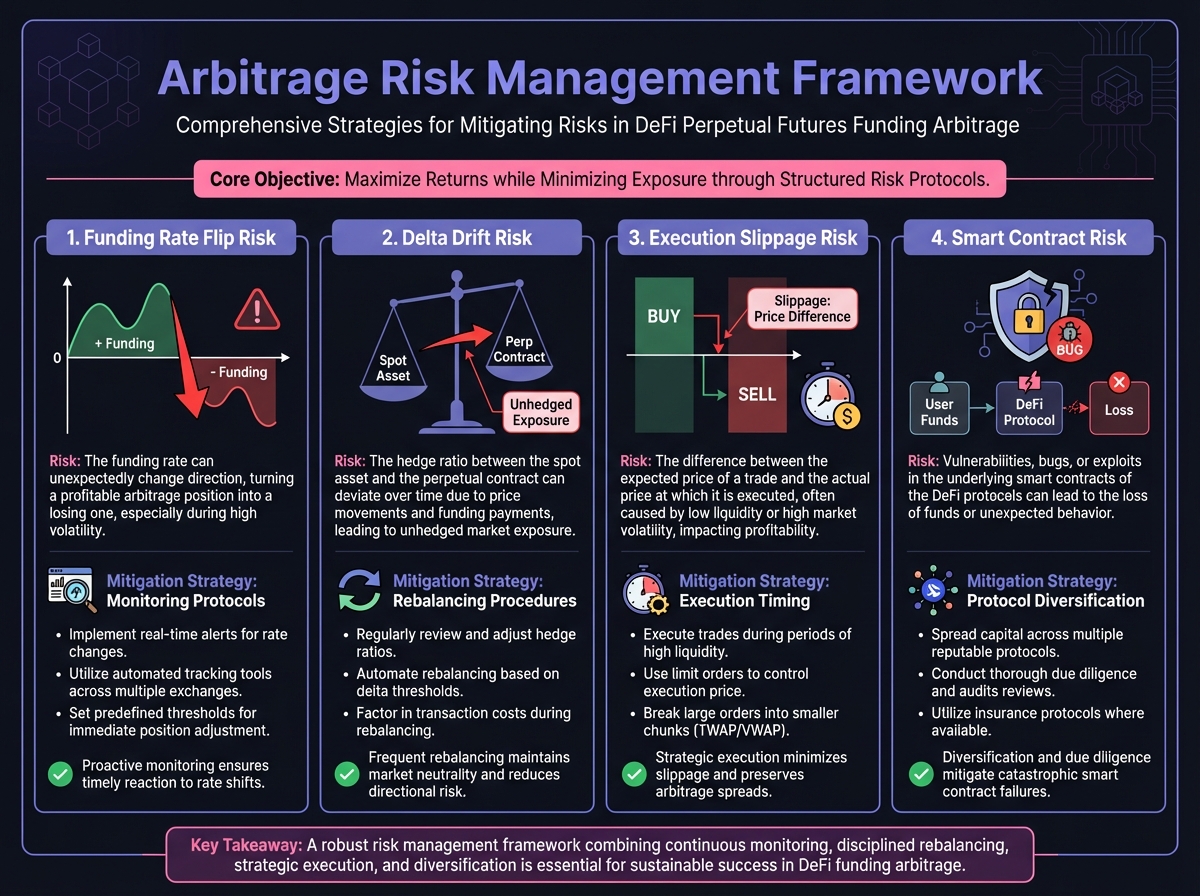
Risks and Mitigation
Risk 1: Funding Rate Flips
- Problem: Positive funding becomes negative
- Impact: You now pay instead of receive
- Mitigation: Monitor rates, close if flips
Risk 2: Delta Drift
- Problem: Positions become unbalanced
- Impact: Price exposure re-emerges
- Mitigation: Regular rebalancing
Risk 3: Execution Slippage
- Problem: Can't execute simultaneously
- Impact: Temporary price exposure
- Mitigation: Use limit orders, execute during low volatility
Risk 4: Smart Contract Risk
- Problem: Protocol exploits or failures
- Impact: Loss of capital
- Mitigation: Diversify across protocols, use audited platforms

🔄 Strategy 2: Cash and Carry Basis Trade
The Concept
Basis: Difference between perpetual price and spot price
Cash and Carry: Exploit basis by shorting perp and buying spot
How It Works:
- If perp > spot: Short perp, buy spot
- Funding rate forces convergence
- Capture the basis spread
Example
Setup:
- Spot ETH: $2,500
- Perp ETH: $2,600
- Basis: $100 (4%)
- Funding rate: 0.1% per hour (very high)
Execution:
- Buy 1 ETH spot: $2,500
- Short 1 ETH perp: $2,600
- Initial profit: $100 (basis capture)
- Ongoing: Earn funding rate
Convergence:
- Funding rate forces perp price toward spot
- When they converge, close both positions
- Total profit: Basis + Funding received
When to Use
Ideal Conditions:
- Large basis (>2%)
- High funding rate
- Expected convergence
- Sufficient liquidity
Avoid When:
- Basis is small (<0.5%)
- Funding rate is low
- High execution costs
- Illiquid markets

🌐 Strategy 3: Cross-Protocol Arbitrage
The Opportunity
Different protocols, different funding rates:
- Protocol A: 0.05% per hour
- Protocol B: 0.02% per hour
- Difference: 0.03% per hour arbitrage
Execution
Setup:
- Long on Protocol A (paying 0.02%)
- Short on Protocol B (receiving 0.05%)
- Net: Receive 0.03% per hour
Example:
- Position size: $10,000 each side
- Funding received (Protocol B): $12/day
- Funding paid (Protocol A): $4.80/day
- Net profit: $7.20/day
- Annualized: 26.3% APR
Considerations
Challenges:
- Bridge costs between protocols
- Different liquidation mechanics
- Monitoring complexity
- Capital requirements (need margin on both)
Benefits:
- Diversified risk (not single protocol)
- Capture rate differentials
- Scale across multiple venues
📊 Strategy 4: Funding Rate Prediction
The Concept
Predict funding rate changes before they happen
Indicators:
- Open Interest trends
- Price momentum
- Market sentiment
- Historical patterns
Execution
Setup:
- Monitor OI and price trends
- Predict funding will increase
- Position before rate spikes
- Capture high rates early
Example:
- Current funding: 0.01% per hour
- OI becoming imbalanced (80% Long)
- Predict funding will spike to 0.05%
- Open short position early
- Capture full 0.05% when it spikes
Risks
Prediction Risk:
- Funding may not spike as expected
- OI may rebalance quickly
- Market conditions change
Mitigation:
- Use multiple indicators
- Start with small positions
- Monitor closely
- Have exit strategy
🎓 Beginner's Corner: Simple Funding Capture
Your First Arbitrage
Start Small:
- Capital: $1,000
- Market: ETH (most liquid)
- Protocol: GMX V2 (zero slippage)
Steps:
- Check ETH funding rate on GMX
- If >0.02% per hour, proceed
- Buy $500 ETH spot (on Uniswap or CEX)
- Short $500 ETH perp on GMX (1x leverage)
- Monitor daily
- Close when funding flips negative
Expected Return:
- Funding: 0.02% per hour = 175% APR
- On $500 perp: ~$2.40/day
- After gas and fees: ~$2/day
- Monthly: ~$60 (6% on $1,000)

Key: Start small, learn mechanics, scale gradually.
🔬 Advanced Deep-Dive: Optimized Arbitrage
Multi-Asset Strategies
Diversification:
- ETH arbitrage: $5,000
- BTC arbitrage: $5,000
- SOL arbitrage: $5,000
- Total: $15,000 capital
Benefits:
- Diversified across assets
- Capture best rates across markets
- Reduce single-asset risk
Automated Strategies
Bot Requirements:
- Monitor funding rates across protocols
- Execute when opportunities arise
- Rebalance automatically
- Risk management rules
Considerations:
- Development costs
- Monitoring infrastructure
- Gas optimization
- Risk of bugs
Yield-Bearing Collateral Enhancement
Extended/Drift Advantage:
- Use stETH as collateral
- Earn staking yield (4% APR)
- Plus funding arbitrage (10% APR)
- Total: 14% APR delta-neutral
Example:
- Deposit $10,000 stETH
- Open short ETH perp
- Earn: Staking yield + Funding
- Net cost: Minimal (funding may offset)
⚠️ Critical Risks
Funding Rate Volatility
The Problem: Rates can flip quickly
Example:
- Open short at 0.05% per hour (receiving)
- Market sentiment shifts
- Rate flips to -0.05% per hour (paying)
- Now losing money
Mitigation: Set alerts, monitor closely, have exit plan
Execution Risk
The Problem: Can't execute simultaneously
Example:
- Buy spot ETH at $2,500
- Try to short perp, but price moved to $2,520
- Now have $20 price exposure
Mitigation: Use limit orders, execute during low volatility, accept small exposure
Protocol Risk
The Problem: Smart contract exploits
Example:
- Protocol gets hacked
- Funds locked or stolen
- Arbitrage position can't be closed
Mitigation: Diversify, use audited protocols, monitor security
Capital Efficiency
The Problem: Need capital for both sides
Example:
- Want $10,000 arbitrage
- Need $10,000 for spot
- Need $10,000 margin for perp
- Total: $20,000 required
Mitigation: Use protocols with cross-margin, leverage spot (carefully)
📊 Real-World Example: Complete Arbitrage Setup
Opportunity:
- ETH spot: $2,500
- ETH perp: $2,550 (basis: 2%)
- Funding rate: 0.03% per hour (positive)
- Annualized: 262% APR
Execution:
- Buy 4 ETH spot: $10,000
- Short 4 ETH perp: $10,000 notional
- Initial profit: $200 (basis capture)
- Daily funding: $7.20/day
- Monthly: $216 + $200 = $416
ROI: 4.16% monthly on $10,000 capital
Monitoring:
- Check funding rate daily
- Rebalance if delta drifts >5%
- Close if funding flips negative
- Target: Hold until basis converges
🛠️ Arbitrage Tools
Use these calculators to plan your arbitrage strategies:
Funding Rate Calculator

Launch Funding Rate Calculator →
Delta-Neutral Position Builder

Launch Delta Neutral Builder →
🔑 Key Takeaways
- Delta-neutral yield farming captures funding without price risk
- Cash and carry exploits basis between spot and perp
- Cross-protocol arbitrage captures rate differentials
- Funding prediction can enhance returns
- Start small, learn mechanics, scale gradually
- Monitor closely—rates can flip quickly
- Diversify across assets and protocols
- Use yield-bearing collateral when possible
🚀 Next Steps
- Proceed to Lesson 10 to learn advanced risk management
- Complete Exercise 9 to design your arbitrage strategy
- Start with small positions to learn
- Monitor funding rates across protocols
Next Lesson: In Lesson 10, we'll explore risk management and position protection.