Lesson 12: Building Your Professional Trading System
🎯 Core Concept: Systems Over Trades
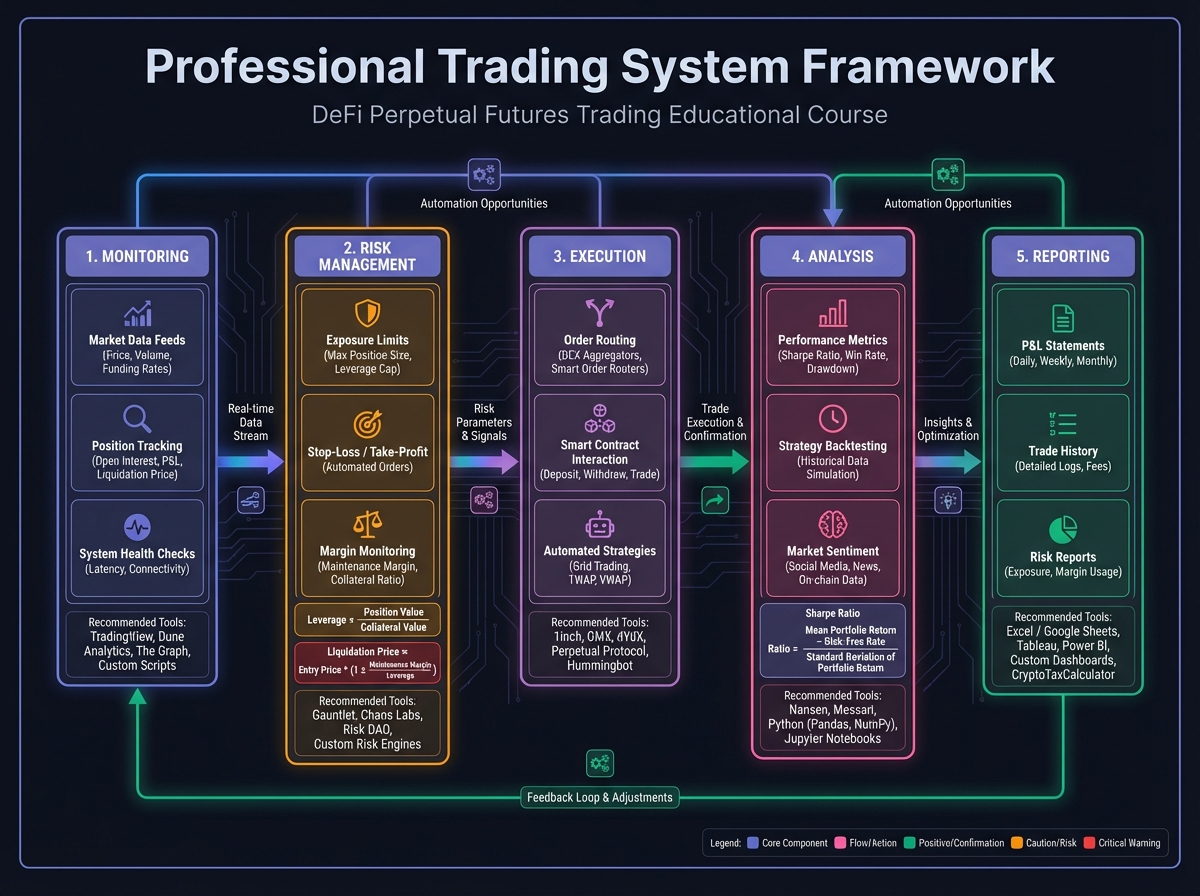
Professional traders don't rely on luck or intuition—they build systematic frameworks that guide every decision. This final lesson synthesizes everything you've learned into a comprehensive trading system that you can implement, monitor, and continuously improve.
Why Systems Matter
The Statistics:
- 70-90% of retail traders lose money
- Professional traders use systematic approaches
- Consistency beats occasional wins
Your System Should Include:
- Due diligence framework
- Protocol selection criteria
- Risk management rules
- Position sizing formulas
- Monitoring procedures
- Performance tracking
- Continuous improvement process

📋 Due Diligence Framework
Protocol Evaluation Checklist
Before Using Any Protocol:
Security:
- Multiple independent audits (OpenZeppelin, Trail of Bits, Spearbit)
- Active bug bounty program
- Insurance fund exists and is funded
- No recent major exploits
- Battle-tested (operational >6 months)
Economics:
- TVL > $10M (minimum threshold)
- Open Interest growing (not declining)
- Revenue > Token emissions (real yield)
- Fee structure sustainable
- Tokenomics make sense
Technical:
- Oracle architecture robust (low latency, multiple sources)
- Liquidation mechanism clear
- Smart contracts verified on-chain
- Documentation comprehensive
- Community active and helpful
Red Flags:
- ❌ Single audit from unknown firm
- ❌ "Audit in progress" (should be done)
- ❌ No insurance fund
- ❌ TVL < $1M (too risky)
- ❌ Emissions > Revenue (unsustainable)
Due Diligence Scorecard
Create Your Own:
| Category | Weight | Score (1-10) | Weighted Score |
|---|---|---|---|
| Security | 40% | ___ | ___ |
| Economics | 30% | ___ | ___ |
| Technical | 20% | ___ | ___ |
| Community | 10% | ___ | ___ |
| Total | 100% | ___/10 |
Minimum Score: 7/10 to use protocol
🎯 Protocol Selection Framework
Decision Matrix
Your Criteria (rank by importance):
- Execution Quality: CEX-like / Good / Acceptable
- Liquidity Depth: Deep / Moderate / Thin
- Fee Structure: Low / Moderate / High
- Features: Advanced / Standard / Basic
- Chain Preference: Your preferred chain
- Risk Profile: Low / Moderate / High
Protocol Scoring:
| Protocol | Execution | Liquidity | Fees | Features | Chain | Risk | Total |
|---|---|---|---|---|---|---|---|
| Hyperliquid | ___/10 | ___/10 | ___/10 | ___/10 | ___/10 | ___/10 | ___/60 |
| GMX V2 | ___/10 | ___/10 | ___/10 | ___/10 | ___/10 | ___/10 | ___/60 |
| Drift | ___/10 | ___/10 | ___/10 | ___/10 | ___/10 | ___/10 | ___/60 |
| EdgeX | ___/10 | ___/10 | ___/10 | ___/10 | ___/10 | ___/10 | ___/60 |
Top Choice: _______ Backup Choice: _______
Multi-Protocol Strategy
Why Diversify:
- Different protocols excel at different things
- Reduces single-protocol risk
- Access to best features
- Optimize execution
Allocation Framework:
- Primary Protocol: 60-70% (best overall fit)
- Secondary Protocol: 20-30% (specific use cases)
- Tertiary Protocol: 10% (experimental/niche)
Example:
- Hyperliquid: 60% (primary, best liquidity)
- GMX V2: 30% (large orders, zero slippage)
- EdgeX: 10% (mobile trading)
💰 Risk Management Framework
Position Sizing Rules
Capital Allocation:
- Total Trading Capital: $_______
- Risk Per Trade: _______% (1-5% recommended)
- Maximum Concurrent Positions: _______
- Maximum Portfolio Risk: _______% (<10%)
Position Size Formula:
Position Size = (Capital × Risk Per Trade) ÷ (Entry - Stop Loss)
Example:
- Capital: $10,000
- Risk: 2% = $200
- Entry: $2,500
- Stop: $2,400
- Position: $200 ÷ ($2,500 - $2,400) = $2,000
- Margin: $2,000 ÷ 5x = $400
Leverage Guidelines
By Experience Level:
- Beginner: 2x-3x maximum
- Intermediate: 3x-5x maximum
- Advanced: 5x-10x maximum
- Professional: 10x-20x (with strict risk management)
By Asset:
- Blue-chip (BTC, ETH): Up to 10x
- Mid-cap: Up to 5x
- Volatile/New: Up to 3x
- Meme coins: Avoid or 2x maximum
Stop Loss Rules
Mandatory Rules:
- Always set stop loss before opening position
- Never move stop loss against you
- Use technical levels (support/resistance)
- Maintain 20-30% buffer above liquidation
- Respect stop loss when hit (no exceptions)
Stop Loss Placement:
- Long: Below support level
- Short: Above resistance level
- Buffer: 20-30% from liquidation price
📊 Portfolio Construction
Diversification Strategy
Across Assets:
- BTC: _______%
- ETH: _______%
- Altcoins: _______%
- Stablecoins: _______%
Across Protocols:
- Protocol 1: _______%
- Protocol 2: _______%
- Protocol 3: _______%
Across Strategies:
- Directional trading: _______%
- Arbitrage: _______%
- LP provision: _______%
Correlation Management
Avoid Over-Concentration:
- Don't trade only ETH-beta assets
- Diversify across uncorrelated assets
- Monitor portfolio correlation
Hedging Strategies:
- Long BTC, Short ETH (if correlated)
- Use cross-margin for hedging
- Monitor correlation changes
📈 Monitoring and Analytics
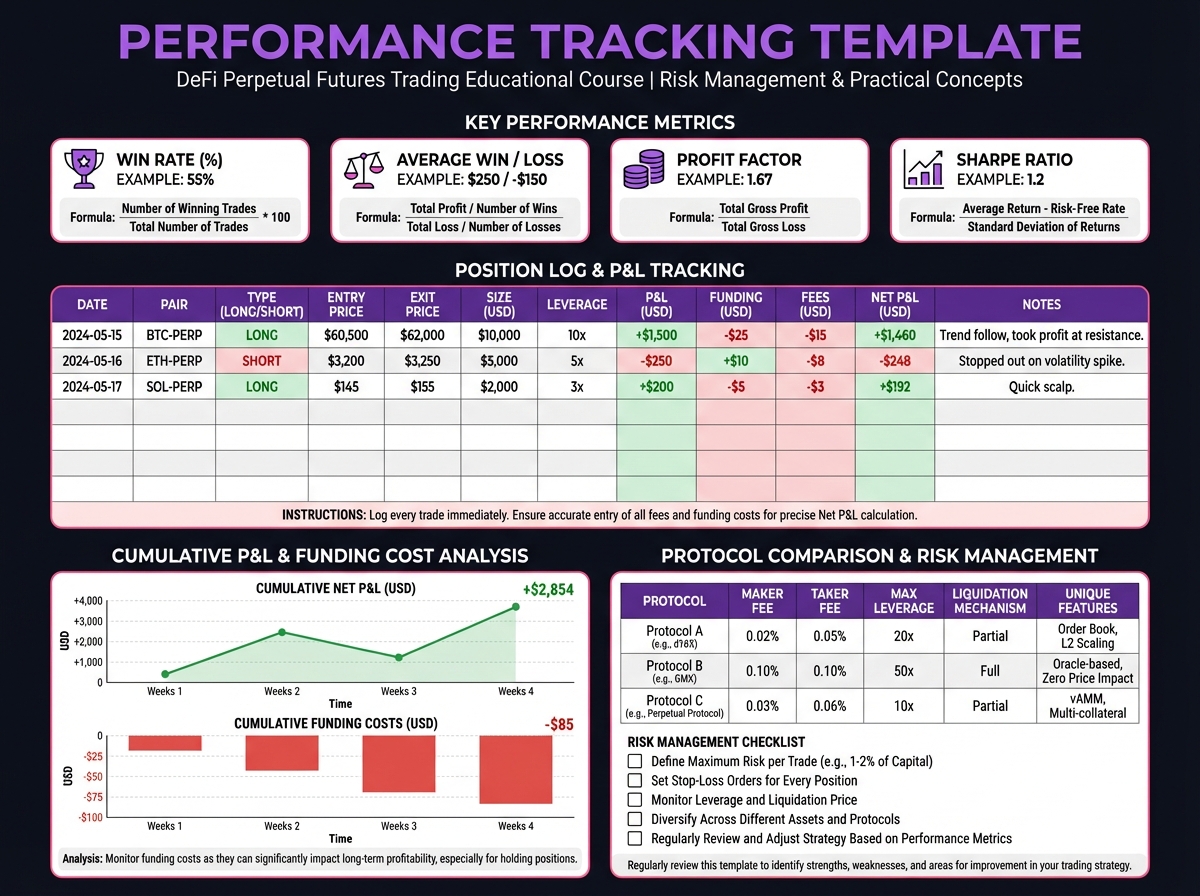
Key Metrics to Track
Position Metrics:
- Unrealized P&L
- Margin ratio
- Distance to liquidation
- Funding costs
- Time in position
Portfolio Metrics:
- Total portfolio value
- Portfolio health factor
- Total risk exposure
- Win rate
- Average win/loss ratio
Protocol Metrics:
- Funding rates across protocols
- Liquidity depth
- Open Interest trends
- Fee costs
Monitoring Schedule
Active Trading:
- Check positions: Every few minutes
- Review portfolio: Hourly
- Full analysis: Daily
Swing Trading:
- Check positions: Daily
- Review portfolio: Weekly
- Full analysis: Monthly
Never: Set and forget—always monitor.
Alert System
Set Alerts For:
- Margin ratio < 15%
- Within 5% of liquidation
- Funding rate > 0.05% per hour
- Stop loss hit
- Take profit hit
- Protocol issues (monitor Twitter/Discord)
🔄 Continuous Improvement Process
Trade Journal
Record For Every Trade:
- Entry price and time
- Exit price and time
- Position size and leverage
- Reasoning (why you entered)
- Outcome (profit/loss)
- Lessons learned
Analyze Regularly:
- Win rate by strategy
- Average win vs. average loss
- Best/worst trades
- Common mistakes
- Improvement areas
Performance Review
Monthly Review:
- Total P&L
- Win rate
- Best strategy
- Worst strategy
- Risk management adherence
- Protocol performance
Quarterly Review:
- System effectiveness
- Rule adherence
- Strategy evolution
- Protocol changes
- Market condition impact
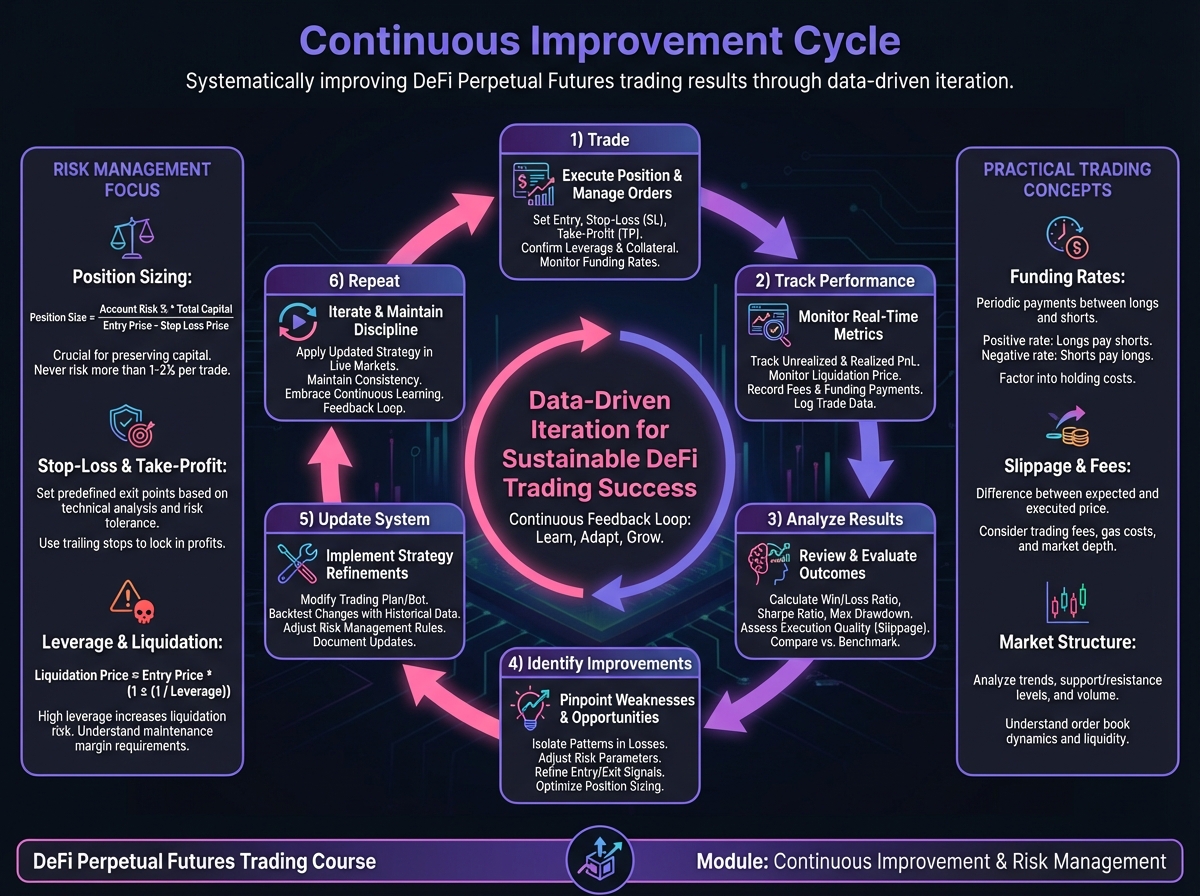
System Refinement
Iterate Based on:
- Performance data
- Market changes
- New protocols/features
- Lessons learned
- Risk events
Process:
- Review performance
- Identify weaknesses
- Update rules/strategies
- Test changes
- Implement if successful
🎓 Beginner's Corner: Your First System
Simple Starter System
Capital: $1,000-5,000
Rules:
- Use only Hyperliquid or GMX V2 (safest)
- Trade only ETH or BTC (most liquid)
- Maximum leverage: 3x
- Risk per trade: 2%
- Always set stop loss
- Use isolated margin only
- Monitor daily
Strategy:
- Swing trading (hold 3-7 days)
- Technical analysis entry
- Stop loss mandatory
- Take profit at 2:1 risk/reward
Goal: Learn mechanics, not maximize profits.
🔬 Advanced Deep-Dive: Professional Systems
Multi-Strategy Framework
Strategy Allocation:
- Directional trading: 40%
- Funding arbitrage: 30%
- LP provision: 20%
- Experimental: 10%
Risk Budget:
- Each strategy: Independent risk budget
- Total portfolio risk: <10%
- Correlation considered
Automated Systems
Bot Infrastructure:
- Price monitoring
- Position management
- Risk checks
- Alert system
- Performance tracking
Considerations:
- Development costs
- Maintenance requirements
- Bug risks
- Gas optimization
Institutional-Grade Monitoring
Tools:
- Custom dashboards
- Real-time alerts
- Performance analytics
- Risk metrics
- Protocol monitoring
Infrastructure:
- Dedicated monitoring
- 24/7 availability
- Redundant systems
- Backup plans
📊 Real-World Example: Complete System
Trader Profile: Intermediate, $10,000 capital
Protocol Selection:
- Primary: Hyperliquid (60% - best liquidity)
- Secondary: GMX V2 (30% - large orders)
- Mobile: EdgeX (10% - mobile trading)
Risk Management:
- Risk per trade: 2% ($200)
- Maximum positions: 3 concurrent
- Maximum portfolio risk: 6%
- Leverage: 3x-5x maximum
Position Sizing:
- Formula: (Capital × 2%) ÷ (Entry - Stop)
- Example: ($10,000 × 0.02) ÷ $100 = $2,000 position
Monitoring:
- Daily position checks
- Weekly portfolio review
- Monthly performance analysis
- Alerts for critical thresholds
Strategies:
- Directional: 60% (swing trading)
- Arbitrage: 30% (funding capture)
- LP: 10% (GMX pools)
Results Tracking:
- Monthly P&L
- Win rate
- Best/worst trades
- System improvements
🔑 Key Takeaways
- Build a systematic framework, don't trade on emotion
- Due diligence is non-negotiable—evaluate every protocol
- Diversify across protocols, assets, and strategies
- Risk management rules must be followed religiously
- Monitor actively—never set and forget
- Track performance to identify improvements
- Iterate and refine your system continuously
- Start simple, scale gradually
- Systems beat individual trades
- Professional traders use frameworks, not luck
🚀 Next Steps
- Complete Exercise 12 to design your personal trading system
- Implement your system with small positions
- Track performance and refine
- Scale gradually as you gain experience
- Stay updated on new protocols and features
- Join trading communities for support
Remember: Building a professional trading system takes time. Start with the basics, learn from every trade, and continuously improve. The goal is sustainable, consistent performance, not quick wins.
Course Complete: Congratulations on completing the Perpetual Futures Trading course!