Lesson 7: Drift Protocol - Solana's Hybrid Architecture
🎯 Core Concept: The Liquidity Trifecta
Drift Protocol V2 represents a "third-generation" derivatives protocol that combines the best of multiple models. Instead of choosing between AMM or order book, Drift uses a three-layer liquidity system that protects LPs from toxic flow while providing traders with optimal execution.
Why Drift Matters
Drift's hybrid approach solves key problems:

- LP Protection: JIT auction prevents toxic flow from hitting AMM first
- Price Precision: DLOB provides limit orders and precise pricing
- Always-On Liquidity: DAMM ensures liquidity always exists
- MEV Internalization: Value goes to traders, not arbitrageurs
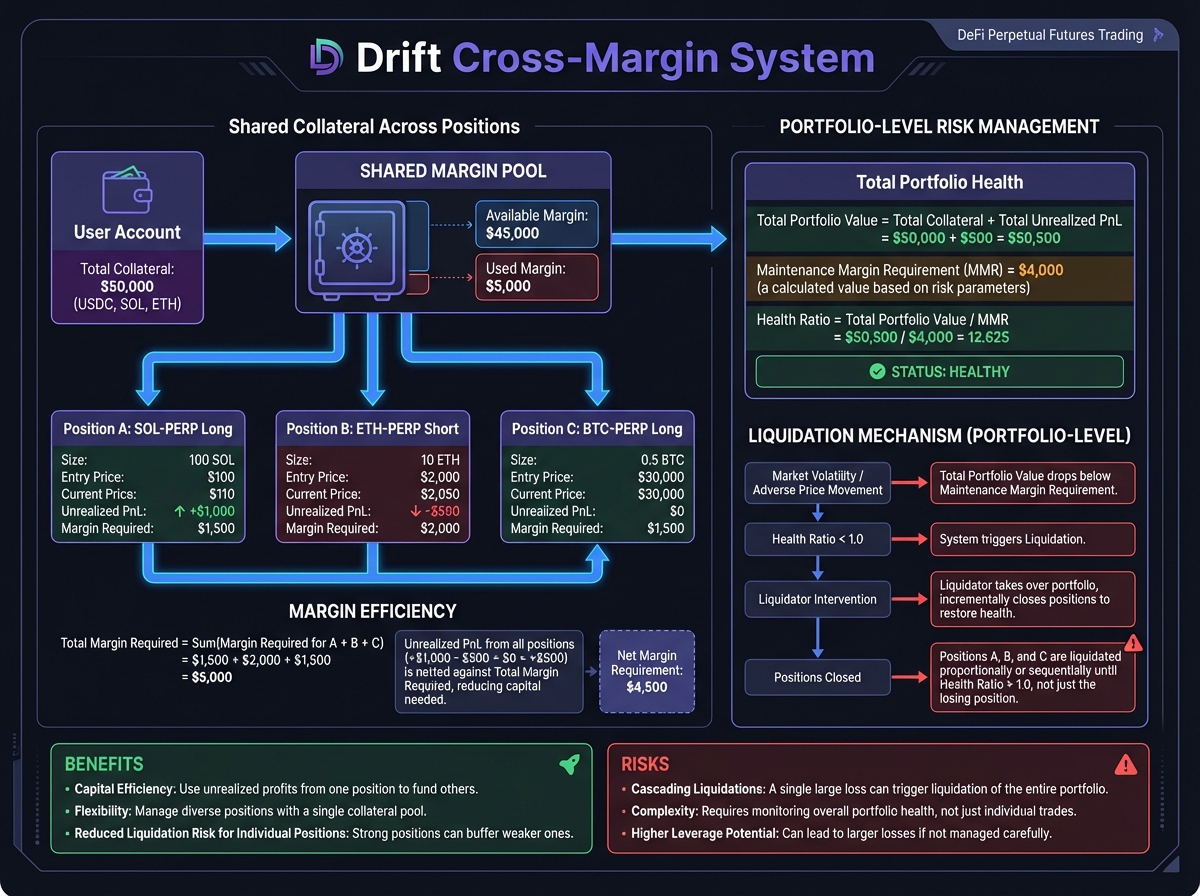
- Cross-Margin: Unified margin across spot, perps, lending, and prediction markets

🏗️ The Liquidity Trifecta Architecture
Layer 1: Just-In-Time (JIT) Auction
How It Works:
- When trader submits market order, it enters 5-second auction
- Market makers compete to fill order at better price than AMM
- Best price wins the fill
- If no maker fills, order moves to next layer
The Innovation:
- Inverts toxic flow dynamic
- Makers must compete (not just pick off stale AMM)
- Traders get price improvement
- LPs protected (AMM is last resort)
Example:
- Trader wants to buy 100 SOL-PERP
- AMM price: $150
- Maker 1 offers: $149.50 (better!)
- Maker 2 offers: $149.00 (even better!)
- Maker 2 wins, trader gets $1 better execution
Layer 2: Decentralized Limit Orderbook (DLOB)
How It Works:
- Off-chain order network maintained by Keepers
- Orders matched off-chain, settled on-chain
- Supports advanced order types (limit, stop, oracle-pegged)
Order Types:
- Limit Orders: Standard maker orders
- Stop-Market/Stop-Limit: Risk management orders
- Oracle-Pegged: Float at fixed offset to oracle (e.g., "Oracle - $0.50")
Why Off-Chain Matching:
- Solana allows high-speed state updates
- But full on-chain orderbook = expensive and state bloat
- Hybrid: Computation off-chain, settlement on-chain
Security: Keepers can't manipulate execution—smart contract verifies signed intent.
Layer 3: Dynamic AMM (DAMM)
How It Works:
- Virtual AMM using constant product formula ($x \cdot y = k$)
- Dynamic adjustments (re-pegging and k-adjustment)
- Serves as backstop (only fills residual flow)
Re-Pegging (Oracle Offset):
- Curve mid-price updated to align with oracle
- Prevents permanent price deviation
- Reduces arbitrage opportunities
Dynamic k (Liquidity Depth):
- Increase k: Low volatility, balanced OI → reduce slippage
- Decrease k: High volatility, extreme imbalance → widen spreads, protect fund
Key Design: DAMM is last resort—JIT and DLOB fill first, protecting passive LPs.
🔄 Trade Execution Lifecycle
The Waterfall Process
Step 1: Order Submission
- User submits market order (e.g., "Buy 100 SOL-PERP")
Step 2: JIT Auction (5 seconds)
- Order broadcast to market makers
- Makers compete to fill at better price
- Best price wins
Step 3: DLOB Execution
- If JIT expires or partially fills, remaining goes to DLOB
- Matches against resting limit orders
Step 4: DAMM Execution
- Any remaining quantity routes to DAMM
- AMM fills residual flow
Result: Traders get best execution, LPs protected from toxic flow.
💰 Cross-Margin System
Unified Margin Across Products
Drift's cross-margin system is unique—it integrates:
- Spot Trading: Buy/sell actual assets
- Perpetual Swaps: Leveraged derivatives
- Money Markets: Borrow/lend
- Prediction Markets: B.E.T platform
How It Works:
- All positions share same collateral pool
- Portfolio value = sum of all assets
- Margin calculated across entire portfolio
- Profits in one position offset losses in another
Asset Weightings
Tiered System (not all collateral equal):
| Asset Type | Example | Initial Weight | Maintenance Weight |
|---|---|---|---|
| Stablecoin | USDC | 1.00x | 1.00x |
| Blue Chip | SOL | 0.80x | 0.90x |
| Volatile | BONK | 0.50x | 0.70x |
Why Weightings:
- Riskier assets discounted for margin calculation
- Prevents over-leveraging on volatile collateral
- Protects protocol from liquidation failures
Cross-Margin Benefits
Hedging Example:
- Long BTC perpetual: $10,000
- Short ETH perpetual: $10,000
- If BTC pumps and ETH dumps, profits offset losses
- Prevents premature liquidation
Capital Efficiency:
- One collateral pool for all positions
- No need to allocate margin per position
- Better utilization of capital
🎓 Beginner's Corner: Using Drift
Getting Started
Step 1: Solana Wallet
- Install Phantom or Solflare wallet
- Fund with SOL (for gas) and USDC (for trading)
Step 2: Connect to Drift
- Navigate to Drift interface
- Connect wallet
- Approve permissions
Step 3: Deposit
- Click "Deposit"
- Select asset (USDC recommended)
- Enter amount
- Approve transaction
Opening a Position
Step-by-Step:
- Select market (e.g., SOL-PERP)
- Choose direction (Long/Short)
- Set size and leverage
- Review funding rate
- Set stop loss (recommended)
- Submit order
- JIT auction runs (5 seconds)
- Order fills at best available price
Key Features:
- Cross-margin: All positions share collateral
- Advanced orders: Limit, stop, oracle-pegged
- Unified interface: Spot, perps, lending in one place
🔬 Advanced Deep-Dive: JIT Auction Mechanics
The Dutch Auction Formula
Pricing Formula: $$Quote = \frac{DAMM_{bid} \cdot (X-t) + DAMM_{est_entry} \cdot t}{X}$$
Where:
- $X$ = Total auction duration (5 seconds)
- $t$ = Time elapsed
- $DAMM_{bid}$ = Current AMM bid price
- $DAMM_{est_entry}$ = Estimated AMM entry price
Interpretation: As auction progresses, price converges toward AMM price, incentivizing early bids.
MEV Internalization
Traditional AMM Problem:
- Arbitrageur sees stale AMM price
- Front-runs trader order
- Extracts value from LPs
Drift's Solution:
- JIT auction forces arbitrageurs to fill order
- Must offer better price than AMM
- Value goes to trader (price improvement)
- LPs protected (AMM not hit first)
Result: MEV is internalized for trader benefit, not extracted by bots.
⚠️ Risks and Considerations
Solana-Specific Risks
Network Congestion:
- Solana can experience congestion
- Transactions may fail or delay
- Monitor network status
Validator Centralization:
- Solana has fewer validators than Ethereum
- Potential for coordination
- Monitor validator health
Cross-Margin Risks
Contagion Risk:
- One bad position can affect entire portfolio
- All positions share collateral
- Monitor portfolio health factor
Complexity Risk:
- Multiple products in one system
- Harder to track all positions
- Requires active management
Keeper Network Risk
Centralization:
- If Keepers collude, could manipulate
- Monitor keeper performance
- Check keeper decentralization
📊 Real-World Example: Trading on Drift
Scenario: Cross-margin strategy with hedging
Setup:
- Deposit: $5,000 USDC
- Long BTC-PERP: $10,000 (2x leverage)
- Short ETH-PERP: $10,000 (2x leverage)
- Net exposure: ~0 (hedged)
Execution:
- Connect Phantom wallet
- Deposit $5,000 USDC
- Open Long BTC-PERP ($10,000, 2x)
- Open Short ETH-PERP ($10,000, 2x)
- Monitor portfolio health
Benefits:
- Hedged position (BTC/ETH correlation)
- Cross-margin efficiency
- Unified interface
- Advanced order types
Monitoring:
- Portfolio health factor
- Individual position P&L
- Funding costs
- Cross-margin utilization
⚖️ Compare Protocols
See how Drift compares to other perpetual DEXs:
🔑 Key Takeaways
- Drift uses three-layer liquidity (JIT, DLOB, DAMM) for optimal execution
- JIT auction protects LPs and improves trader prices
- Cross-margin system integrates spot, perps, lending, and prediction markets
- Solana's speed enables off-chain matching with on-chain settlement
- Asset weightings manage risk for volatile collateral
- Best for: Active traders, cross-margin strategies, Solana ecosystem users
🚀 Next Steps
- Proceed to Lesson 8 to learn about alternative chain protocols
- Complete Exercise 7 to practice Drift strategy analysis
- Explore Drift's cross-margin system
- Consider JIT participation for market making
Next Lesson: In Lesson 8, we'll explore alternative chain protocols.